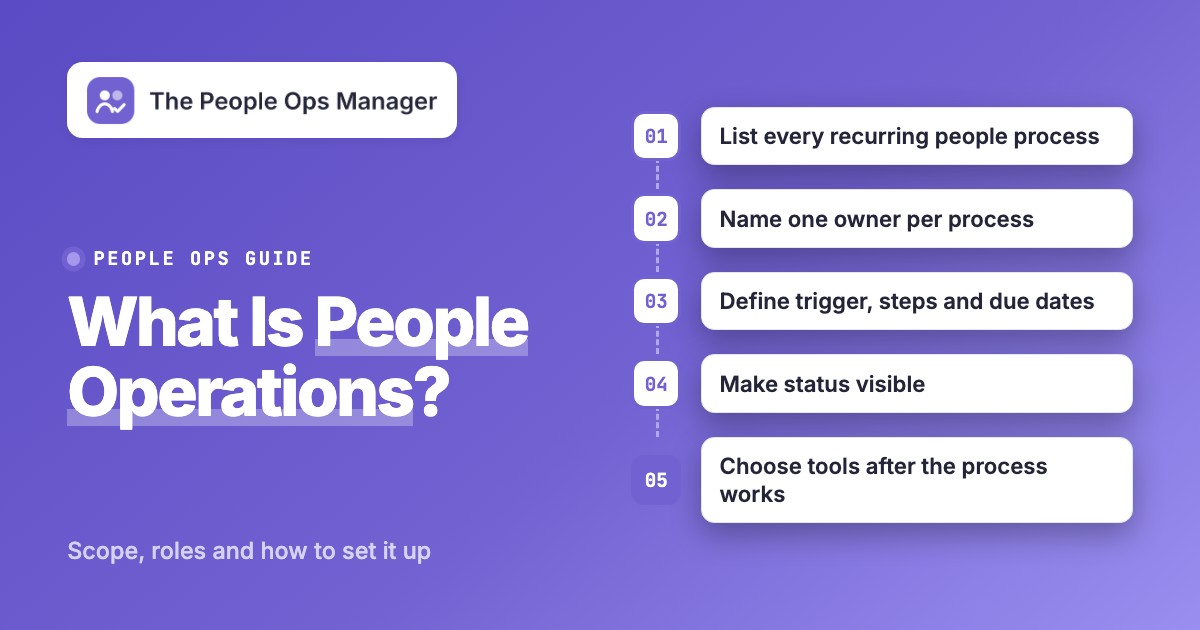
People operations is the function that runs how a company hires, onboards, pays, develops and supports its employees, treated as an operational system rather than a stack of paperwork. It does the same legal and administrative work HR has always done, but it adds employee experience, data and internal tooling on top. The name is most common in tech companies and startups, though it's spreading. This guide explains what people operations is, where the term came from, how it differs from HR, what a team covers, which roles exist and how to set the function up in a growing company. It's written for founders, People leads and HR generalists at companies with roughly 30 to 1,000 employees.
- People operations (People Ops) is the function that designs and runs the employee lifecycle: hiring handoffs, onboarding, records, payroll and benefits inputs, development, culture and employee service.
- The term comes from Google, where Laszlo Bock led the function from 2006 and applied operations thinking and data to people work.
- It isn't a replacement for HR. The legal and administrative work stays, and the emphasis shifts to employee experience, measurement and proactive process design.
- Titles vary a lot: People Operations Manager, People Partner, People Analyst and Employee Experience Specialist all sit under the label.
- It usually breaks at handoffs between HR, IT, finance and managers, so every process needs one owner, a trigger and a due date.
What Is People Operations?
People operations, often shortened to People Ops, is the business function that designs and runs the employee lifecycle as a set of repeatable processes. It covers hiring handoffs, onboarding and offboarding, employee records, payroll and benefits inputs, performance and development cycles, culture programs and employee questions. What sets it apart from a traditional HR department is the working method: processes get owners, due dates and measurements, and the team tries to fix problems before an employee has to raise them.
A People Ops team still handles contracts, compliance and records, because those tasks are legally required whatever the department is called. The real difference is how the work is framed. A traditional HR team often asks whether a task was done correctly. A People Ops team also asks, quite deliberately, whether the employee's experience of that task was good and whether the process can run without somebody remembering to chase it.
In practice, "people operations" describes a way of working, not a fixed org chart. A ten-person startup may have one person doing everything under that name. A 500-person company may have a People Ops team of six that sits next to a separate talent acquisition team and a few HR business partners.
Where Does the Term People Operations Come From?
The label was popularized by Google. Laszlo Bock joined Google in 2006 as head of its people function, which the company called People Operations, and he later described the approach in his book Work Rules! (Hachette, 2015). Bock came from an operations and statistics background, and he brought data, testing and process improvement into hiring and other people decisions, as Wharton's coverage of his work describes. That's where the "operations" in the name comes from: treat people work like any other business process that can be measured and improved.
Since then, many fast-growing companies have adopted the name or a close variant such as People & Culture, People Team or Employee Success. The label isn't standardized, though, and it's easy to over-read. Some large companies that've kept a very traditional HR function use "People Operations" for only one sub-team, the one that owns systems and processes. When a job ad or org chart uses the term, the responsibilities listed matter more than the title.
How Is People Operations Different From HR?
People operations and HR overlap heavily. HR is the long-established function built around employment law, administration, relations and risk. People operations is a newer approach that keeps those duties and puts more weight on employee experience, data and process design. Plenty of companies that say "People Ops" still run what's really an HR function with a different philosophy on top, and that's fine. The question that matters is what a given team owns, not what it's called.
| Dimension | Traditional HR | People operations |
|---|---|---|
| Main orientation | Compliance, policy, risk | Employee experience, process and measurement |
| Typical stance | Responds when something comes up | Designs the process so fewer things come up |
| Core skills | Employment law, employee relations, administration | Process design, people analytics, systems, cross-team coordination |
| Common in | Large and regulated organizations | Startups, scale-ups and tech companies |
| Typical roles | HR Manager, HR Generalist, HR Business Partner | People Operations Manager, People Partner, People Analyst |
| Owns systems | Often shares ownership with IT | Usually owns the HRIS and the people tool stack |
The split isn't either/or. Regulated employers really do need need the audit trail that traditional HR is built around, and fast-growing companies need the process discipline People Ops brings. Most healthy teams do both. If you want the day-to-day mechanics view, see the guide to HR operations, which is the execution layer that a People Ops team sits on top of.
What Does a People Operations Team Cover?
A People Operations team typically covers seven areas. In a small company one person owns several of them, and in a larger company each area gets a specialist. The table shows what each area includes and where the work usually lives.
| Area | What it includes | Where it usually lives |
|---|---|---|
| Hiring handoffs | Offer approval, start date confirmed, background check status, handoff to onboarding | Applicant tracking system |
| Onboarding and offboarding | Paperwork, accounts, equipment, first-week plan, exit tasks and access removal | HRIS plus a task tool |
| Employee records and systems | Employee data, HRIS configuration, integrations, access and data audits | HRIS |
| Pay and benefits inputs | New hires, changes, time data, benefit enrollment and life events | Payroll and benefits platforms |
| Performance and development | Review cycles, goals, learning programs, promotion processes | Performance tool |
| Culture and employee experience | Surveys, recognition, internal communications, events | Survey and engagement tools |
| Employee service and compliance | Questions, document requests, I-9 and filing deadlines, policy upkeep | Shared inbox, help desk, checklists |
Two points stand out clearly. Most areas touch another team, so the real skill in People Ops is coordination, and that's much harder than data entry. And most areas have a clock attached, whether that's a start date, a pay cutoff or a legal filing window. The tool categories in the third column are compared in the guides to HR software, HRIS software, employee onboarding software and employee experience software. The compliance side is covered in the HR compliance guide.
What Roles Exist in People Operations, and What Do They Pay?
People Operations roles span coordination, specialist and leadership levels, and the titles are used inconsistently. The list below describes the common ones by responsibility rather than by name.
- People Operations Coordinator or Specialist: processes hires, changes and exits, keeps records accurate, answers employee questions and chases open tasks.
- People Operations Manager: owns the processes and the systems, runs onboarding and offboarding end to end, reports on the data and manages compliance deadlines. In a smaller company this is often the first People hire.
- People Partner: advises managers and teams on performance, development and employee relations. It overlaps with an HR business partner.
- People Analyst: builds the reporting on headcount, turnover, hiring speed and engagement results.
- Head or Director of People Operations: sets the function's roadmap, budget and tool stack, and works with finance and legal.
Employer job descriptions for a People Operations Manager commonly ask for several years of experience in a fast-changing company, working knowledge of HRIS and payroll systems, comfort with spreadsheets and reporting, and a good grasp of employment law and confidentiality. Entry points are usually coordinator or HR generalist roles, and they're open to people from many backgrounds. Many people move across HR and People Ops titles during a career.
On pay, titles don't map cleanly, and that's a real problem for comparisons. The US Bureau of Labor Statistics doesn't track People Operations as its own occupation. For the nearest category, it reports a median annual wage of $140,030 for human resources managers in May 2024. Coordinator and specialist roles pay considerably less, but pay for any given People Ops job depends mostly on seniority, company size and location rather than on the title.
When Does a Company Need People Operations?
There's no headcount at which a People Ops function becomes mandatory, but some situations make the need very visible. A founder or office manager who's handling onboarding and payroll questions on the side is the first. New hires who arrive without laptops or accounts are another. So are compliance deadlines tracked in someone's calendar, and the same employee questions that get answered in five different channels.
A useful rule is to look at where time goes, and you'll usually see it quickly. When people with other jobs spend a noticeable share of every week chasing onboarding tasks, answering benefit questions or fixing records, the company is already paying for people operations. It's simply paying with scattered effort and without anyone accountable for it. The first People Ops hire often pays for itself, because they take that load off founders, managers and finance, and it's usually obvious within a quarter.
How Do You Set Up People Operations?
You set up people operations by turning the recurring work into named processes with owners, then adding measurement and tooling in that order. The steps below work whether you're a one-person team or you're planning a first hire.
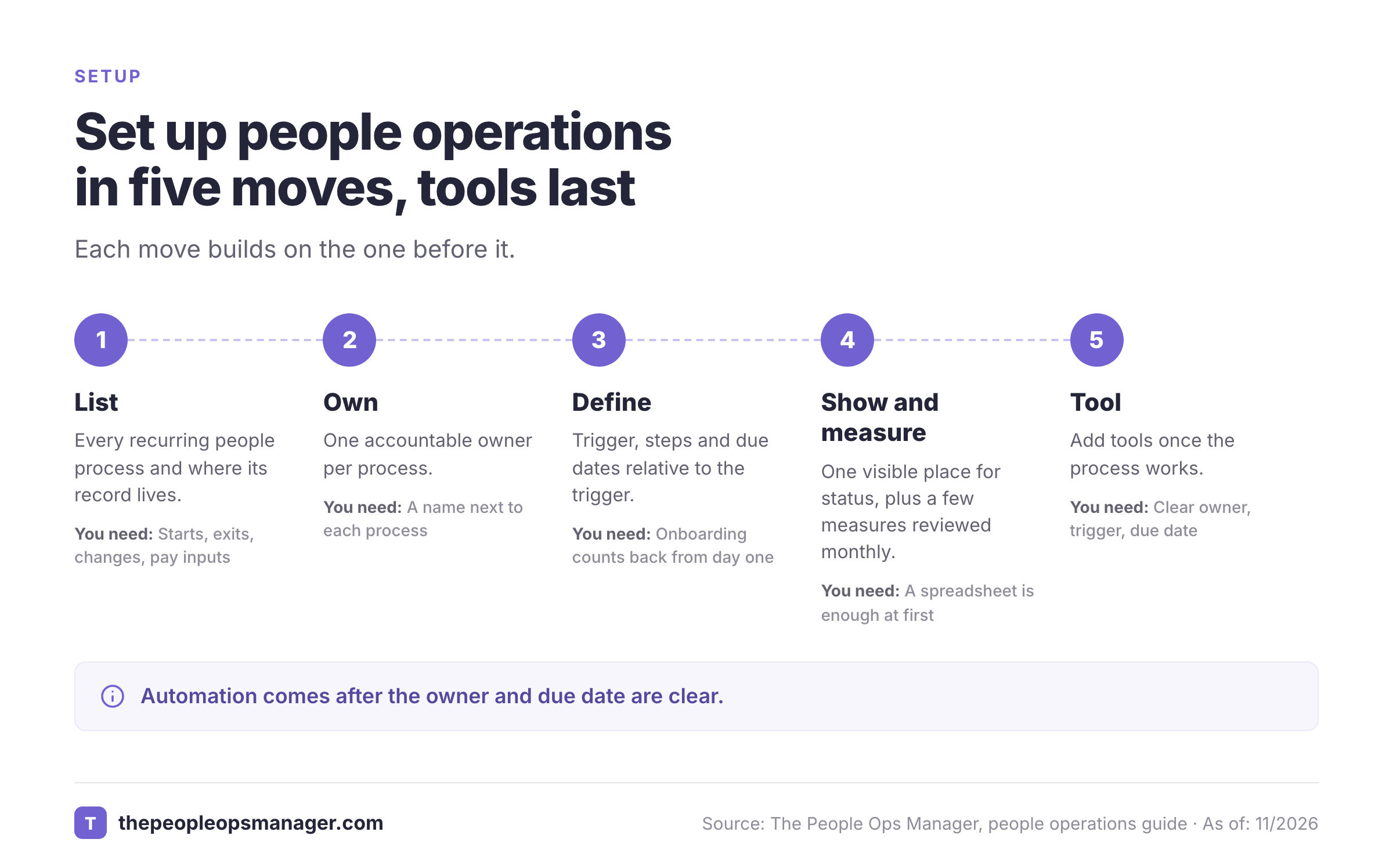
List every recurring people process
Write down what happens each week and month: hires, exits, role and pay changes, pay cycle inputs, leave cases, review cycles and compliance filings. Note who does each one today and where the record lives. Most teams find work that nobody's owned, and some they didn't know existed.
Name one owner per process
An owner is a single person accountable for the process finishing on time, even when other teams do some of the steps. Shared ownership usually means that nobody is accountable.
Define trigger, steps and due dates
For each process, record what starts it, the steps in order, who does each one and when it's due relative to the trigger. For onboarding, the trigger is the accepted offer and the due dates count back from day one.
Make status visible
Choose one place where anyone can see which steps are done, which are due and which are blocked. A spreadsheet is enough for the first quarter. The point is that status doesn't live in people's heads and inboxes anymore.
Pick a few measures and review them monthly
Track a small set: time from accepted offer to ready for day one, share of new hires fully set up on day one, request response time and turnover in the first 90 days. Measure first, and don't set targets until you've seen a few months of data.
Choose tools after the process works
Add or change tools only once the owner, trigger and due date are clear. Automation on an unclear process simply delivers the mistake faster. The HR automation guide lists which workflows to automate first.
Where Does People Operations Break?
People operations breaks at handoffs, where one team finishes its part and another has to act. That's the whole problem, really. It doesn't break inside a single team. The HRIS can be accurate and payroll configured correctly, and a new hire can still arrive without access because the request to IT went out three days late. Each team did its part, yet nobody was watching the whole chain.
The timeline below is a standard onboarding handoff chain with an owner for each step, counted from the first day.
- RecruiterOffer accepted; start date confirmed in the system Day -14
- People OpsEmployee record created; onboarding plan generated with owners and due dates Day -10
- Hiring managerApproves equipment and system access; first-week plan and buddy assigned Day -5
- ITAccounts, laptop and access requests fulfilled after manager approval Day -3
- New hireForm I-9 Section 1 completed and Form W-4 signed Day 1
- People OpsForm I-9 Section 2 completed after document examination Within 3 business days of start
- FinanceNew hire appears correctly in the next payroll run Before the first pay cycle cutoff
The same pattern applies to exits, role changes and leave. A tool that coordinates these steps across systems, such as The People Ops Manager, only helps once the owners and due dates above exist. The detailed version of this chain is in the employee onboarding process guide, and the onboarding checklist turns it into a list you can reuse.
Which Metrics Show Whether People Operations Works?
Good People Ops metrics measure the process and the employee's experience of it, instead of just volume. Start with a handful you can pull without a project: days from accepted offer to ready for day one, the share of new hires with accounts and equipment on their first morning, time to first response on employee requests, the number of open tasks past their due date and early turnover. Pair these with a short survey at 30 and 90 days, because the numbers can't show how a new hire felt. The HR metrics guide covers definitions and formulas for the wider set.
People Operations FAQ
What is people operations?
People operations is the function that designs and runs the employee lifecycle as a set of repeatable, measured processes: hiring handoffs, onboarding, records, pay and benefits inputs, development, culture and employee service. It includes the legal and administrative work of HR and adds a stronger focus on employee experience and data.
What is the difference between people operations and HR?
HR is the traditional function built around employment law, administration, employee relations and risk. People operations does the same core work and puts more weight on employee experience, process design and measurement. In many companies the two names describe the same team, so compare the responsibilities rather than the titles.
Is people operations just a rebrand of HR?
Partly. The legal and administrative duties don't change, and many teams called People Ops are essentially HR teams. The term does carry a distinct working style, borrowed from operations management at Google, that treats people work as processes to design, measure and improve.
What does a people operations manager do?
A people operations manager owns the processes and systems behind the employee lifecycle. That includes onboarding and offboarding, employee records, payroll and benefits inputs, compliance deadlines and reporting, and often the HRIS and related tools. They coordinate with recruiting, IT, finance and hiring managers.
Is a career in people operations a good choice?
It really suits people who like process, systems and working across teams, and it leads to roles from specialist to head of People. Skills transfer between HR and people operations titles, and many people move across both. Pay depends mostly on seniority, company size and location.
When should a startup hire its first people operations person?
There's no fixed headcount. Hire when founders, managers or finance spend a noticeable share of each week on onboarding, records, benefits questions or compliance tracking, and when missed handoffs start to affect new hires. The role often pays for itself by returning that time.