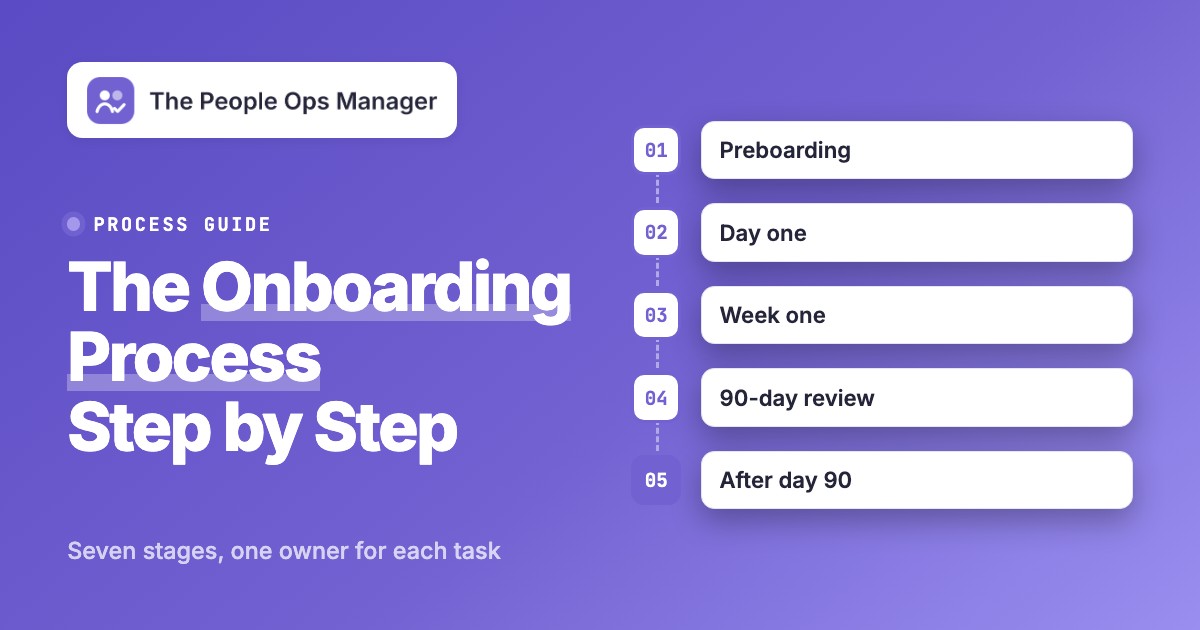
The employee onboarding process is the set of steps between a signed offer and the point where a new hire works independently, usually around day 90. It breaks when nobody owns the handoffs: HR waits on the manager, IT waits on HR, and the new hire finds out on day one that the laptop never shipped. This guide lists the seven stages, names one owner per task, adds suggested lead times and shows where the process most often stalls.
Two parts are sourced from primary pages: the US paperwork deadlines (USCIS, IRS and the federal child support agency) and the 30-60-90 check-in model (SHRM). Lead times and the worked example are practical guidance from how onboarding usually runs, and they're labeled that way. None of this is legal advice.
- Onboarding starts when the offer is accepted, not on day one, and runs in seven stages up to the period after day 90.
- Every task needs exactly one owner, a suggested lead time and a named dependency. HR coordinates, but it shouldn't be the default owner of every task.
- Form I-9 Section 1 is due no later than the first day of employment, and Section 2 within three business days of the hire.
- Most stalled first days trace back to three rules: identity comes before access, equipment has the longest lead time and approvals come before grants.
- SHRM recommends check-ins at 30, 60 and 90 days to catch problems early.
What Is the Employee Onboarding Process?
The employee onboarding process is the structured sequence of tasks that takes a new hire from accepted offer to productive team member. It covers paperwork, equipment and accounts, orientation, role training and early feedback, and it is usually planned to run for the first 90 days. Some companies stretch it to a full year. In order, the steps are preboarding, day one, week one, the first month, the second month, the third month and the period after day 90.
Three terms get mixed up, so the boundaries are worth stating. Each one below is a different thing:
- Recruiting ends when the candidate accepts the offer. Onboarding starts at that moment, not on day one.
- Orientation is one event inside onboarding, typically a session in the first days covering policies, tools and introductions.
- An onboarding program is the documented version of the process: the stages, owners, templates and check-ins your company repeats for every hire.
Seen this way, onboarding isn't a single HR task but a chain of small handoffs between four groups: HR, IT, the hiring manager and facilities, with finance or payroll joining for pay setup. The rest of this guide treats those handoffs as the thing to manage.
Onboarding Process Steps at a Glance
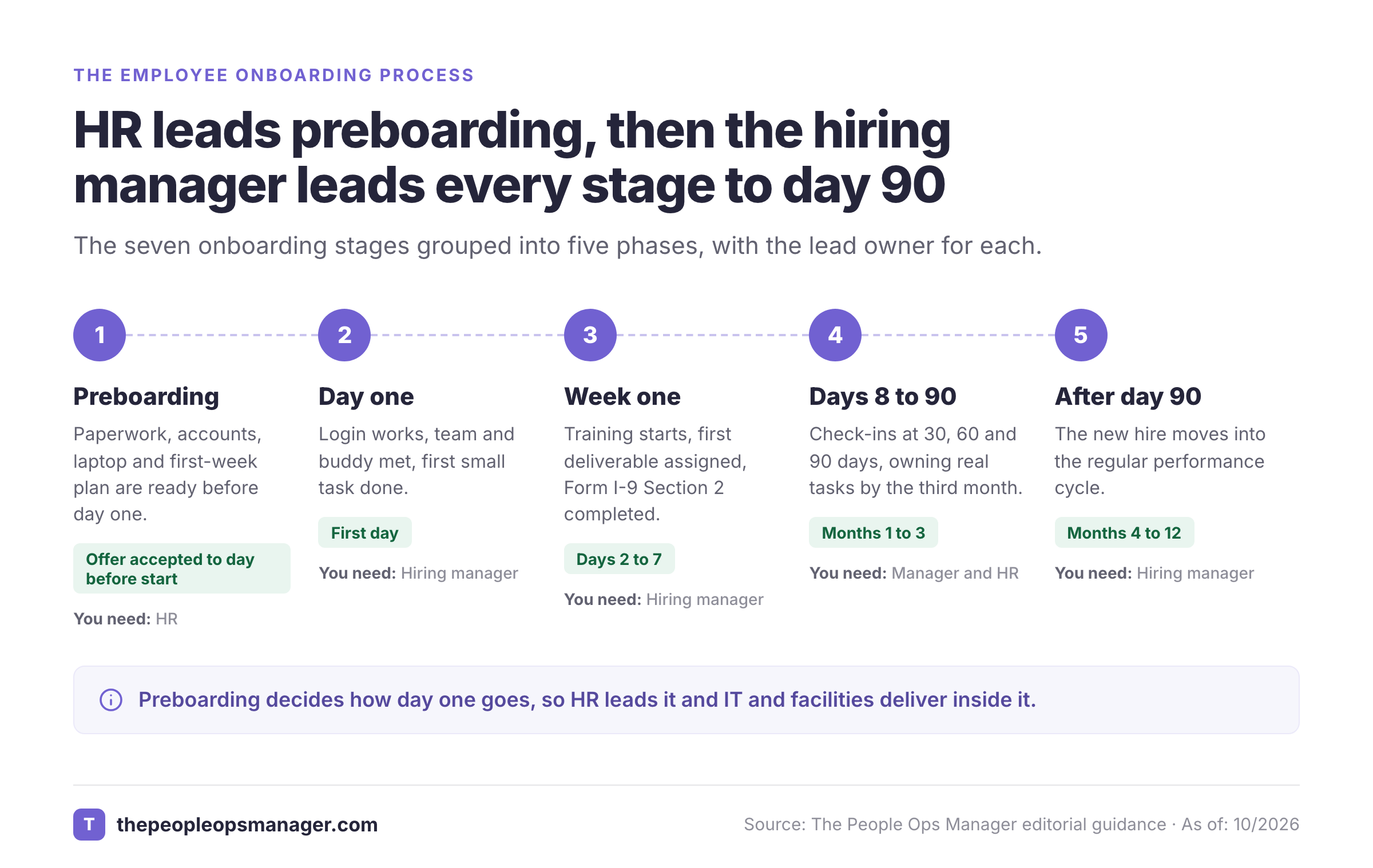
Seven stages make up the process, and each has one lead owner plus a result that must exist before the next stage can start.
| Stage | Timing | Lead owner | Result before moving on |
|---|---|---|---|
| 1. Preboarding | Offer accepted to the day before start | HR, with IT and facilities | Paperwork started, equipment and accounts ready, manager has a first-week plan |
| 2. Day one | First day | Hiring manager | New hire logged in, met the team, knows the first week |
| 3. Week one | Days 2 to 7 | Hiring manager | Core training started, first small task done, Form I-9 Section 2 complete |
| 4. Days 8 to 30 | First month | Hiring manager | Role basics learned, 30-day check-in held |
| 5. Days 31 to 60 | Second month | Hiring manager | Owns real tasks, 60-day check-in held |
| 6. Days 61 to 90 | Third month | Hiring manager and HR | Works independently, 90-day review held |
| 7. After day 90 | Months 4 to 12 | Manager, with HR | Moves into the regular performance cycle |
The image below shows the same flow with the owner for each handoff.
The 7 Stages of the Onboarding Process
Stage 1: Preboarding (offer accepted to the day before start)
Preboarding is the work that happens between the signed offer and the first morning, and it is where most day-one failures are decided. HR owns it, but three other groups have to deliver something inside it.
HR sends the welcome message, the start date, the first-day schedule and the paperwork packet. For hourly staff, the first shifts come from a scheduling tool, so collect availability in the same step and compare options in our employee scheduling software guide. The employee completes Section 1 of Form I-9 no later than the first day of employment, so sending it early keeps day one clear. The employer can review the identity documents any time after the offer is accepted and Section 1 is done.
IT creates the accounts and orders the laptop. This is the longest lead time in the process, because hardware can be on backorder and access requests often need an approval. Facilities prepares the desk, badge and building access for on-site hires. The hiring manager writes a first-week plan, picks a buddy and tells the team who is arriving.
A useful rule for this stage: instead of saving tasks for day one, finish anything that could have been done the week before.
Stage 2: Day one
Day one should answer three questions for the new hire: can I log in, who do I ask, and what am I doing this week. The hiring manager owns the day. HR owns the welcome session if the company runs one, and IT owns a short fix-it window in the morning for anything that doesn't work.
A workable day-one agenda has five parts, and a short orientation is enough for the fourth.
- Manager welcome and a walk through the first-week plan
- Laptop, accounts and building access confirmed working
- Introductions to the team and the assigned buddy
- A short orientation covering policies, tools and who to contact for what
- A first small task that can be finished before the end of the day
Avoid filling the day with every policy at once. A short orientation and a real first task give the new hire something to work from.
Stage 3: Week one
Week one turns the new hire from "set up" into "started." Training begins, the manager assigns a first deliverable with a clear definition of done, and the buddy checks in daily for the first few days.
This is also when the compliance clock runs. The employer completes Section 2 of Form I-9 within three business days of the hire, and the new hire reports into payroll and benefits. Benefits enrollment follows the plan's own enrollment window, which HR should state in the welcome packet so the new hire isn't surprised.
The manager should close the week with a short conversation about what was confusing. That list becomes the first input for improving the process itself.
Stage 4: Days 8 to 30
The first month is about learning the role and the team's way of working. Weekly one-on-ones start, the buddy relationship moves from daily to weekly, and training continues against a short list of skills the manager defined in preboarding.
SHRM recommends scheduled conversations at 30, 60 and 90 days to catch problems early. At 30 days the useful questions are what has gone well, what is still unclear and what turned out different from what the new hire expected. HR can collect those answers in a short survey so patterns show up across hires.
Stage 5: Days 31 to 60
In the second month the new hire takes ownership of real tasks. The manager's job shifts from teaching to coaching: setting a goal, letting the new hire attempt it and giving feedback on the result.
The 60-day conversation covers whether the person has enough time, tools and training, and whether the job matches what was described during hiring. This is the check-in where an access gap or a missing tool tends to surface, because the new hire now needs systems they did not need in week one.
Stage 6: Days 61 to 90
By the third month the new hire should work with limited supervision. The manager and HR hold a 90-day review that looks at the role goals, what the onboarding program did well and what it missed. SHRM's 90-day questions include who helped most, whether expectations were clear and how the new hire would grade the onboarding program, which makes this the best point to collect feedback on the process itself.
Stage 7: After day 90
After day 90 the new hire enters the regular performance cycle. Some companies keep a quarterly check-in through the first year and give the new hire a chance to mentor the next person who starts. Formal onboarding ends here, but the record of what worked stays useful for the next hire.
Who Owns Each Onboarding Task?
Every onboarding task needs exactly one owner, a suggested lead time and a named dependency. The lead times below are practical guidance, not legal or vendor rules; adjust them to how long your own approvals and shipments take.
| Task | Owner | Suggested lead time | Depends on |
|---|---|---|---|
| Send welcome message, schedule and paperwork | HR | Within 2 business days of acceptance | Signed offer |
| Create employee record in the HR system | HR | Before the start date | Signed offer, start date |
| Collect Form I-9 Section 1 and W-4 | HR, new hire | By the first day | Employee record |
| Create email and identity account | IT | 5 business days before start | Employee record |
| Order and configure laptop | IT | 10 business days before start | Role and equipment standard |
| Approve and grant app access | IT, system owner | 2 business days before start | Identity account, manager approval |
| Prepare desk, badge and building access | Facilities | 3 business days before start | Start date, location |
| Set up payroll and bank details | Finance or payroll | Before the first pay run | Employee record, tax forms |
| Write first-week plan and pick a buddy | Hiring manager | 5 business days before start | Role goals |
| Complete Form I-9 Section 2 | HR | Within 3 business days of hire | Documents presented by new hire |
| Report the new hire to the state | HR or payroll | Within the state deadline, up to 20 days | Employee record |
| Hold 30, 60 and 90 day check-ins | Hiring manager | Calendar invites sent on day one | First-week plan |
In this table, HR owns the record and the paperwork, keeps the schedule, and is the escalation point when another group slips. HR doesn't do the work of IT or facilities. The hiring manager owns everything that makes the new hire effective in the role, which is the largest share of the first 90 days.
Where the Onboarding Process Breaks: Handoffs and Dependencies
The process rarely fails because someone forgot a task, but because one task could not start until another finished, and nobody saw the wait. Three dependency rules explain most stalled first days.
Identity comes before access. An app account can't be requested before the employee record and identity account exist. If HR enters the record late, every access request behind it is late too.
Equipment has the longest lead time. A laptop on backorder can't be fixed on day one. Order hardware as soon as the offer is accepted and the role is known, and agree on a fallback device for delays.
Approvals come before grants. Access to sensitive systems should wait for a recorded decision from the system owner or the manager. Granting first and approving later is how audit findings start.
Beyond dependencies, a handful of mistakes repeat across companies:
- Treating onboarding as a one-day orientation event
- Overloading the new hire with information in the first week
- Skipping clear performance expectations
- Using the same checklist for every role
- Never asking the new hire how the process felt
The fix for the first four is the structure in this guide. The fifth is the 30, 60 and 90 day feedback described above.
US Compliance Steps in the Onboarding Process
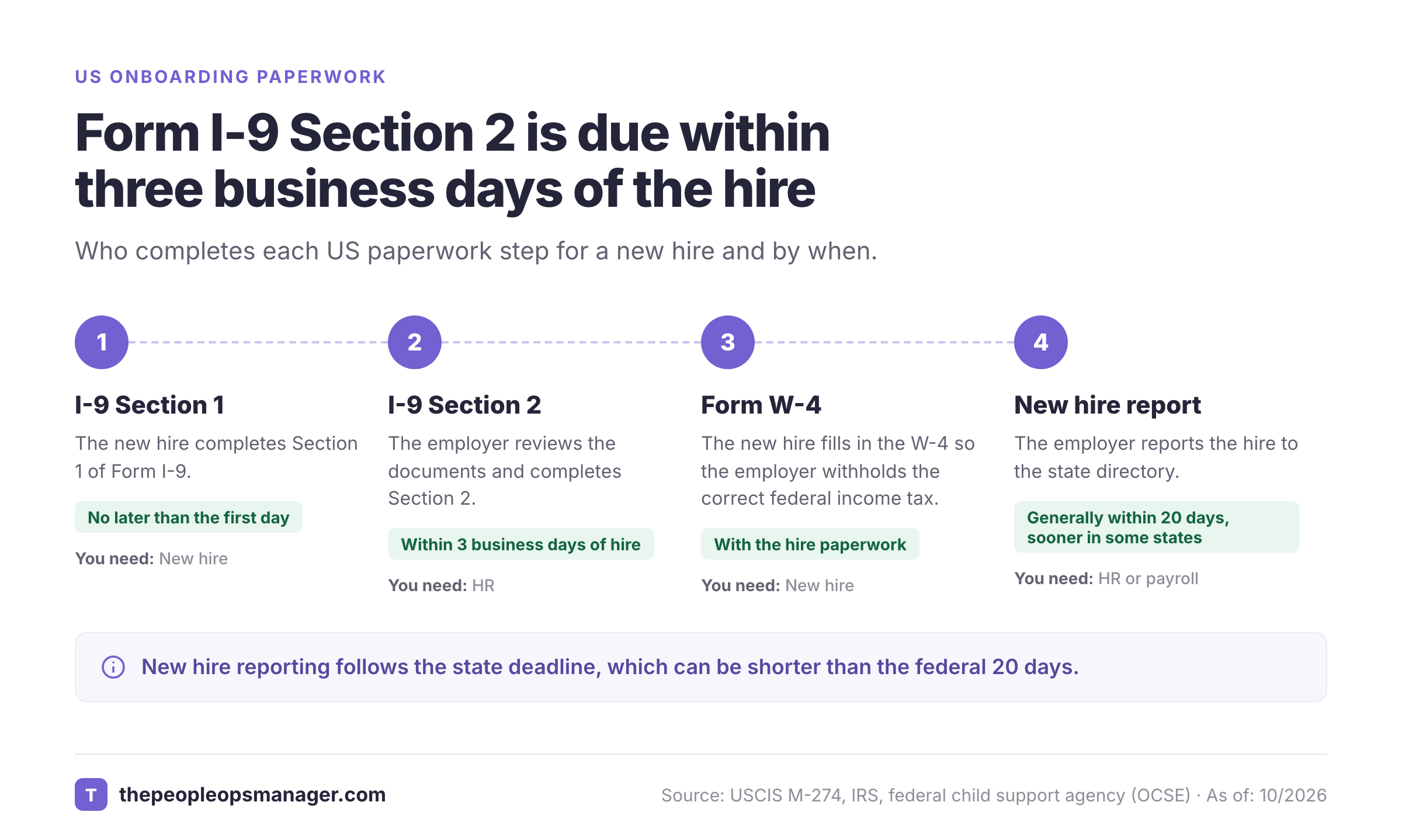
For US employees, three paperwork steps have fixed or externally set clocks. Check each against the primary source, since forms and state rules change.
| Step | Who completes it | Timing | Source |
|---|---|---|---|
| Form I-9, Section 1 | New hire | No later than the first day of employment | USCIS Handbook for Employers (M-274) |
| Form I-9, Section 2 | Employer | Within three business days of the hire | USCIS Handbook for Employers (M-274) |
| Form W-4 | New hire | Completed so the employer can withhold the correct federal income tax | IRS |
| New hire reporting | Employer | Generally within 20 days of hire, sooner in some states | Federal child support agency (OCSE) and state directories |
New hire reporting goes to the state where the employee works, not to a federal office. Federal law sets a 20 day window and states may require it faster, so the safest practice is to follow the state's own deadline. Multistate employers can choose to report all hires to one state under certain conditions, which the federal child support agency (OCSE) explains on its employer pages.
State and local requirements beyond these three vary, including state withholding forms and any local registrations. Ask your payroll provider or an employment attorney for the list that applies to your states. Our comparison of the best payroll software notes which tools include state new-hire reporting.
Employee Onboarding Checklist Template
The checklist below covers a standard office hire. Copy it into your own tool, add a row for anything specific to your company and keep the owner column.
| Phase | Task | Owner | Done |
|---|---|---|---|
| Preboarding | Send welcome message, start date and first-day schedule | HR | ☐ |
| Preboarding | Send paperwork packet including Form I-9 Section 1 and W-4 | HR | ☐ |
| Preboarding | Create employee record | HR | ☐ |
| Preboarding | Create email and identity account | IT | ☐ |
| Preboarding | Order and configure laptop | IT | ☐ |
| Preboarding | Request and approve app access | IT, manager | ☐ |
| Preboarding | Prepare desk, badge and building access | Facilities | ☐ |
| Preboarding | Set up payroll | Finance | ☐ |
| Preboarding | Write first-week plan, pick a buddy, announce the hire | Manager | ☐ |
| Day one | Welcome, tour and first-week walkthrough | Manager | ☐ |
| Day one | Confirm laptop, accounts and badge work | IT | ☐ |
| Day one | Introduce buddy and team | Manager | ☐ |
| Day one | Short orientation on policies and tools | HR | ☐ |
| Week one | Complete Form I-9 Section 2 by day three | HR | ☐ |
| Week one | Start role training and assign a first deliverable | Manager | ☐ |
| Week one | Explain benefits enrollment window | HR | ☐ |
| Week one | End-of-week conversation on what was unclear | Manager | ☐ |
| Day 30 | Hold 30-day check-in and send short survey | Manager, HR | ☐ |
| Day 30 | Report new hire to the state if not already done | HR, payroll | ☐ |
| Day 60 | Hold 60-day check-in on time, tools and training | Manager | ☐ |
| Day 90 | Hold 90-day review and onboarding feedback conversation | Manager, HR | ☐ |
For remote hires, add a shipping task for equipment and a video introduction in week one. The next sections cover that and the 30-60-90 plan.
How Long Should Onboarding Last? The 30-60-90 Day Plan
Structured onboarding typically lasts about 90 days, and the 30-60-90 plan splits that time into three periods with a manager check-in at the end of each; some companies extend support to a year.
| Period | Purpose | Manager's focus | Check-in question |
|---|---|---|---|
| Days 1 to 30 | Learn | Clarity on role, team and tools | What has gone well, and what is still unclear? |
| Days 31 to 60 | Contribute | Real tasks, coaching and feedback | Do you have enough time, tools and training? |
| Days 61 to 90 | Own | Independent work and goals for the next quarter | Were expectations clear, and how would you grade onboarding? |
The questions in the last column are paraphrased from SHRM's 2018 article on onboarding that lasts months. Learn, contribute and own are common shorthand, not SHRM's wording. Managers use a plan more when it fits on one page with three goals per period.
Virtual and Remote Onboarding Process
A virtual onboarding process follows the same seven stages, but three things need extra lead time. Equipment has to ship and arrive before day one, so order it earlier than you would for an office hire and plan for delivery at least a week before the start date. Accounts and sign-in security have to work from home, which means IT should test sign-in before the start date. And introductions need to be planned, because the new hire won't meet people in a hallway.
- Ship the laptop at least a week before start and confirm the delivery address in the welcome message
- Schedule day-one video calls with the manager, buddy and team instead of a tour
- Add a daily 15 minute buddy check-in for the first week
- Plan time zone overlap so the new hire isn't alone during the first morning
- Collect Form I-9 documents through the employer's authorized process for remote verification, and confirm which process your company uses with HR or counsel
Onboarding Process Example: An Engineer Starting on a Monday
The example below is illustrative, not a benchmark. It shows how the owners and lead times fit together for a software engineer who starts on a Monday. Dates are counted in business days.
- HRThe offer is accepted. HR creates the employee record and sends the welcome message and paperwork packet. 15 days before start
- ITIT orders the laptop and creates the identity account. 12 days before start
- ManagerThe manager writes the first-week plan and picks a buddy. 12 days before start
- ManagerThe manager requests access to the code repository and the ticketing system. The system owners approve. 8 days before start
- FacilitiesFacilities prepares the desk and badge. 8 days before start
- ITIT checks that the laptop and accounts work. 3 days before start
- HRHR confirms Form I-9 Section 1 is done and payroll is set up. 3 days before start
- ManagerWelcome, laptop handoff, team and buddy introductions, short orientation, first small task. Day one
- HRHR completes Form I-9 Section 2. Day three
- ManagerThe manager and new hire review the week. Day five
- ManagerCheck-ins and the 90-day review. HR reports the new hire to the state well before the 20 day federal limit. Day 30, 60, 90
If the laptop is delayed in this timeline, the manager sees it three days before start rather than on day one, and the fallback device is arranged in time. That early signal is the main benefit of tracking owners and dependencies.
How to Build and Document Your Own Onboarding Process
You can build a working onboarding process in an afternoon and improve it with every hire. The goal is a short document that the next HR or ops person could run without asking you anything.
List the stages
Start from the seven stages above and delete any that don't apply.
Assign one owner per task
If two groups share a task, pick the group that's blamed when it fails.
Set a lead time per task
Count back from the start date, using your real approval and shipping times.
Write the dependencies
Next to each task, state what must exist before it can start.
Define ready
Decide what has to be true before day one, for example: account created, laptop configured, access approved, first-week plan written.
Run it for the next hire and note what slipped
Edit the process after every hire for the first few rounds.
Keep separate versions only where roles really differ, such as engineering, sales and frontline. One shared base process with short role add-ons is easier to maintain than five full copies.
How to Measure Whether Onboarding Works
Measure the process, not just the hire. Four measures are enough to start, and none needs special software.
- Tasks done before day one. Count how many preboarding tasks were complete the Friday before start.
- Time to ready. Days from accepted offer to a working laptop, account and access.
- Check-in scores. Average of the new hire's answers at 30, 60 and 90 days on whether expectations and tools were clear.
- Early exits. How many new hires leave in the first 90 days, and what they said about onboarding.
Pick a baseline from your last few hires and compare each new one to it. Resist copying outside benchmarks, because your role mix and approval chain differ from other companies.
Where The People Ops Manager Fits
If you're choosing a system for the whole process instead, our guide to the best employee onboarding software compares eleven tools with their published prices.
Onboarding Process FAQ
What are the steps involved in employee onboarding?
Employee onboarding runs from the signed offer through a first day, a first week and three monthly phases, with a named lead for each. Preboarding matters most, because the paperwork, equipment and access done there decide how smooth day one will be.
What is the onboarding session?
The onboarding session, often called orientation, is a scheduled introduction usually held on the first day or in the first week. It typically covers company policies, tools, benefits information and who to contact for what, and it is one event inside the wider onboarding process.
What is the 30-60-90 onboarding rule?
The 30-60-90 rule splits the first 90 days into three periods, with a manager check-in at the end of each. SHRM recommends these conversations as a simple way to find obstacles early. A common framing is learn in the first 30 days, contribute in the next 30 and own the work in the last 30.
How long should the onboarding process last?
Plan for about 90 days of structured onboarding, with optional check-ins through the first year.
What is the role of HR in the onboarding process?
The role of HR in onboarding is to own the employee record, the paperwork, the schedule and the escalation path. Managers own role training and feedback, IT owns accounts and equipment, and facilities owns the physical setup. HR coordinates, and it shouldn't be the default owner of every task.
Can I use a template for an employee onboarding checklist?
Yes, you can use a template for an employee onboarding checklist. Use the checklist table above, keep the owner column and add rows for your company's specific systems and roles.