HR operations is the part of HR that runs the daily mechanics of employment: records, onboarding, payroll inputs, benefits, time and leave, compliance deadlines and employee questions. It's the work that has to happen correctly and on time, even in a week when nobody's thinking about strategy. This guide explains what HR operations covers, how it differs from HR management and people operations, which US deadlines it has to hit, and how to set up a function that doesn't depend on one person's memory. It's written for HR and People Ops leads at US companies with roughly 50 to 1,000 employees.
- HR operations is the execution side of HR: employee data, onboarding and offboarding, payroll and benefits inputs, time and leave, compliance and employee service.
- It differs from HR strategy, which decides what to do, and from HR administration, which is the narrower record-keeping layer inside operations.
- The work breaks at handoffs between HR, IT, finance and managers, not inside any one team.
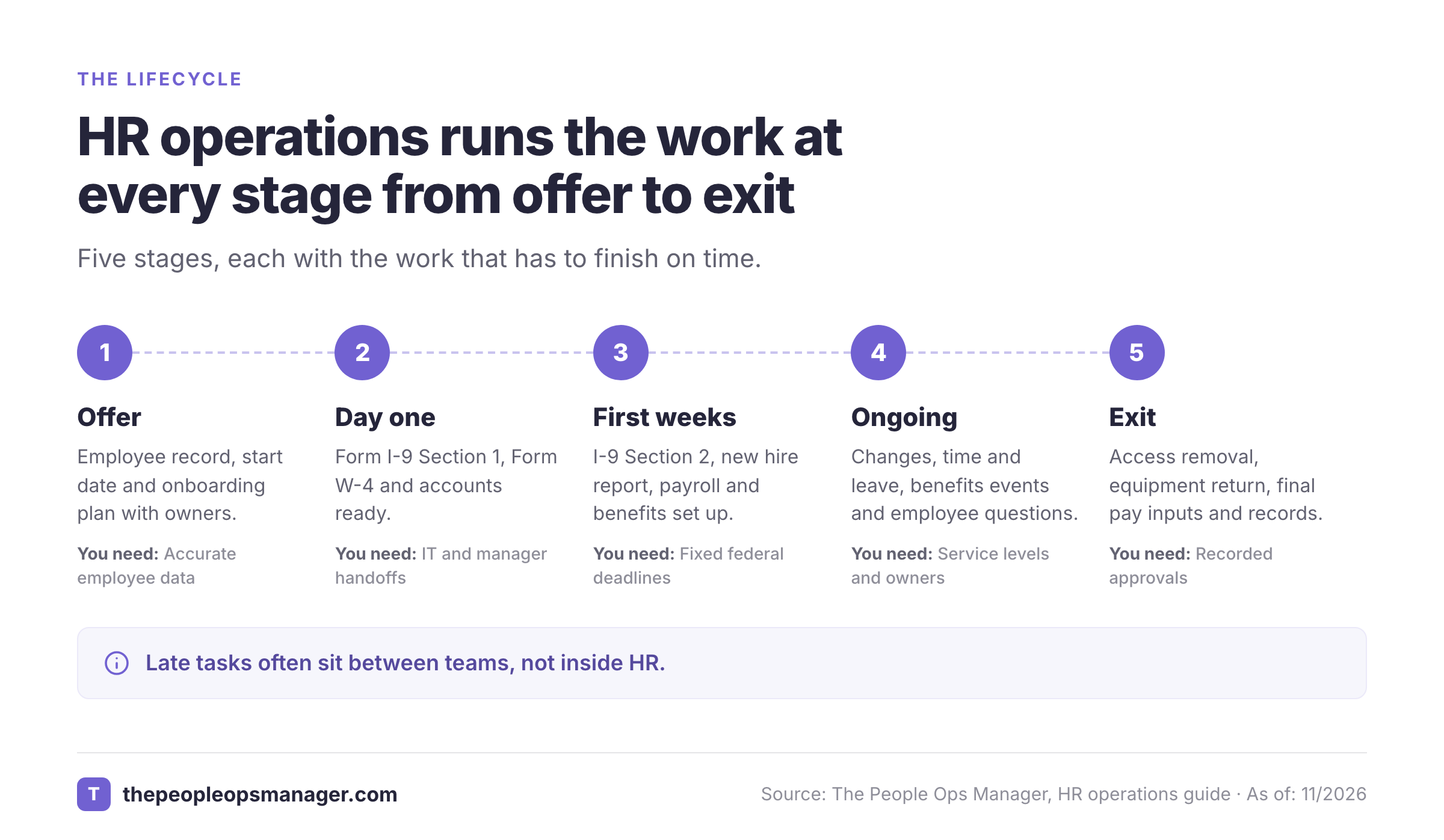
- Fixed US dates drive the calendar: Form I-9 Section 1 by day one, Section 2 within three business days, new hire reporting within 20 days, FMLA notices within five business days.
- Give every process an owner, a trigger, a due date and a visible status before you buy another tool.
What Is HR Operations?
HR operations is the set of day-to-day processes that run the employee lifecycle: keeping employee data accurate, onboarding and offboarding people, feeding payroll and benefits, tracking time and leave, meeting compliance deadlines and answering employee questions. The goal is consistent, compliant service that doesn't change with who happens to be on shift. That's what employees really notice. Strategy decides what the company wants from its people. Operations is how that gets delivered on a Tuesday afternoon, and it's where employees notice whether HR works.
A useful test is repetition. If a task has a trigger, an owner, a due date and a way to tell whether it's done, it belongs to HR operations. A new hire's start date is a trigger, and it's the one that matters most. Collecting a signed Form W-4 is a task with an owner. The fifth business day after a leave request is a deadline. Employee relations judgment calls, compensation philosophy and workforce planning sit around that core, and they depend on it being reliable.
What Does HR Operations Cover?
HR operations covers eight work areas. Which team owns each one varies by company size, and there's no standard split, and in smaller companies a single person covers several of them. The table shows what each area includes, where the record usually lives and the fixed rhythm that shapes the work.
| Work area | What it includes | Usual system | Rhythm |
|---|---|---|---|
| Employee data | Profiles, job and manager changes, document storage, data audits | HRIS | Every change, audited quarterly |
| Onboarding | Paperwork, accounts, equipment, first-week plan | HRIS plus a task tool | Every hire |
| Offboarding | Exit date, access removal, equipment return, final pay inputs | HRIS plus IT tools | Every exit |
| Payroll inputs | New hires, pay changes, time data, deductions | Payroll system | Each pay cycle |
| Benefits | Enrollment, life events, COBRA notices, carrier files | Benefits platform | Open enrollment and each event |
| Time and leave | Time off, timesheets, FMLA and other leave | HRIS or time tool | Daily, with fixed notice dates |
| Compliance | I-9, new hire reporting, record retention, postings | HRIS plus checklists | Calendar-driven |
| Employee service | Questions, document requests, case routing | Shared inbox or HR help desk | Continuous |
Two things clearly stand out. Most areas touch another team, which is why they're rarely clean to own: onboarding needs IT and the hiring manager, payroll inputs need finance, offboarding needs IT again. And most areas have a clock attached. That's exactly why HR operations feels like logistics more than policy work.
The best HR software and HRIS software comparisons cover the systems in the third column. For the service layer, there's a separate comparison of HR service delivery software.
How Is HR Operations Different From HR Management and People Operations?
HR operations is the execution layer of HR. HR management is the broader discipline that also includes strategy, talent decisions and employee relations. People operations is a newer name, common in tech and startups, for a function that blends operations with culture and employee experience. The terms overlap and companies don't use them the same way, so the real question is what a given team owns, not what it's called.
| Term | Focus | Typical question it answers |
|---|---|---|
| HR operations | Executing processes and service | Was every hire's paperwork complete by day three? |
| HR administration | Records, forms and filings inside operations | Is the employee file complete and filed correctly? |
| HR management | Policy, talent, relations and strategy | How should we structure pay bands? |
| People operations | Operations plus employee experience and tooling | What should a new hire's first week feel like? |
| HR business partner | Advising a business unit's leaders | How do we handle a reorganization in sales? |
HR administration is often used as a synonym, but it's much narrower. Administration keeps the record right. Operations makes sure the process around the record runs: who is notified, what happens next and what is late. The same split shows up in job titles, where an HR administrator maintains files and an HR operations specialist owns the process that produces them.
What Does an HR Operations Team Do Every Day?
An HR operations team spends its day on a mix of scheduled tasks, queued requests and exceptions. In a typical week, a specialist processes starts and changes in the HRIS. They check that pending I-9 and W-4 items are complete and answer benefits and leave questions. They reconcile payroll inputs before the cutoff, and they chase open tasks owned by other teams. That last job takes far more time than most job descriptions admit, and it's rarely written down.
It helps to sort requests into three kinds, because they don't all need the same response:
- Routine requests have a known answer or a standard form, such as an employment verification letter or a PTO balance. These belong in self-service or a templated reply, and they shouldn't need a person.
- Process work moves through steps with owners, such as a new hire or a leave case. These need a tracker that shows status and due dates, because they can't be handled in one sitting.
- Exceptions need a person to decide, such as a late I-9 document, a retroactive pay change or a sensitive employee complaint. These need an owner and a clear rule for when to escalate, since there's no standard answer.
Teams that treat all three the same way end up with senior people answering PTO questions, while the exceptions that really matter wait in a shared inbox.
Where Does HR Operations Break?
HR operations breaks at handoffs, where one team finishes its part and another has to act. The HRIS can be accurate and the payroll system can be configured correctly, and a new hire can still arrive without a laptop because the request to IT didn't go out until three days late. Each team did its part, but nobody saw the whole chain, and nobody's job was to.
Here's a standard onboarding handoff chain with an owner on each step. Here, dates are counted from the first day.
- RecruiterOffer accepted; start date confirmed in the system Day -14
- HR operationsEmployee record created; onboarding plan generated with owners and due dates Day -10
- ITAccounts, laptop and access requests fulfilled after manager approval Day -3
- Hiring managerFirst-week plan and buddy assigned Day -2
- New hireForm I-9 Section 1 completed; Form W-4 signed Day 1
- HR operationsForm I-9 Section 2 completed after document examination By day 3 (business days)
- HR operationsNew hire reported to the state Within 20 days of hire
- FinancePayroll and benefit deductions verified Before first pay cycle
Three of those steps depend on someone outside HR, so HR can't fix them alone. If any one of them is late, it looks like an HR failure to the new hire, which is why a shared view of status matters far more than another reminder email. It's the thing that's usually missing. The employee onboarding process guide explains each stage, and the offboarding checklist covers the same chain in reverse.
Which US Deadlines Does HR Operations Have to Hit?
HR operations runs against a handful of federal dates that don't move. State rules can be stricter, of course, so always check yours, especially for new hire reporting, final pay and paid leave. The federal baseline looks like this.
| Obligation | Federal rule | Source |
|---|---|---|
| Form I-9, Section 1 | Employee completes it no later than the first day of employment | USCIS Handbook for Employers (M-274) |
| Form I-9, Section 2 | Employer completes it within three business days of the date employment begins | USCIS M-274 |
| Form W-4 | Ask each new employee for a signed W-4 when they start work | IRS Publication 15 |
| New hire reporting | Report new and rehired employees to the state within 20 days of hire; some states require it sooner | HHS Office of Child Support Services |
| FMLA notices | Eligibility notice and designation notice within five business days, absent extenuating circumstances | 29 CFR 825.300 |
| COBRA election | Qualified beneficiaries have 60 days to elect coverage, counted from the later of the end of coverage or receipt of the election notice | DOL EBSA |
| Payroll records | Keep payroll records at least three years and time cards and wage computation records at least two years | DOL Fact Sheet 21 |
Don't leave these dates in a wiki. Put them in the plan the moment the trigger fires, not when someone happens to remember them. Without question, the cheapest compliance control in HR operations is a due date with an owner attached to every one of these rows. It's cheap, and it always works better than a memory. If you're deciding what to automate, the HR automation guide ranks 15 workflows by trigger and risk, and the HR compliance guide goes deeper on the legal side.
How Do You Build an HR Operations Function?
Build it process by process, never all at once, starting with the ones that fail most visibly. A full redesign takes a year and loses momentum, and it rarely survives a change of leadership, but five good processes take a quarter and show results. The steps below work for a first-time build or a cleanup.
List every recurring HR process
Write down what happens each week and month. Don't polish it: starts, exits, changes, pay cycle inputs, leave cases and compliance filings. Include who does it today and where the record lives. Most teams find processes that nobody's owned, and some they didn't know existed.
Name one owner per process
An owner is one person accountable for the process finishing on time, even when other teams do some steps. Shared ownership usually means no ownership. Write the name next to the process.
Define trigger, steps and due dates
For each process, write what starts it, the steps in order, who does each one and when each is due relative to the trigger. This is the document the onboarding timeline above is an example of.
Make status visible
Pick one place where anyone can see which steps are done, which are due and which are blocked. It doesn't need to be fancy. A spreadsheet works for the first quarter. What matters is that status stops living in people's heads and inboxes.
Set service levels for requests
Decide how fast routine requests get an answer and what counts as an exception. Publish the targets so people know what they're getting. Review them monthly against what actually happened.
Review the numbers monthly
Track a small set of measures, such as the ones in the next section, and fix the process behind any that drift. You'll learn more from three numbers than from thirty. Retire or merge processes that nobody uses.
What Metrics Show That HR Operations Is Working?
An HR operations team should measure timeliness, accuracy and effort, using counts you can pull from the tools you've already got. A short set beats a dashboard of twenty. You can calculate each of these yourself, so set targets from your own baseline rather than a benchmark. Don't copy someone else's.
| Metric | How to calculate it | What it tells you |
|---|---|---|
| Onboarding completion on time | Starters with all tasks done by day one, divided by all starters | Whether handoffs to IT and managers hold up |
| I-9 timeliness | Forms with Section 2 completed within three business days, divided by all new hires | Compliance exposure |
| Request response time | Median hours from employee question to first answer | Service quality |
| Rework rate | Records or payroll inputs corrected after submission, divided by all submitted | Data accuracy |
| Open items past due | Count of tasks beyond their due date, by owner | Where the chain is blocked |
| Cost of HR operations per employee | HR operations spend divided by headcount | Efficiency, read as a trend |
Look at "open items past due" by owner first. It finds the bottleneck far faster than any average does, and it turns a vague complaint about slow onboarding into a named task with a named owner. For a longer menu of measures, see the HR metrics guide.
What Roles Make Up an HR Operations Team?
Roles follow the work areas, and one person often covers several in a smaller company. Titles vary, so read the responsibilities rather than the label, since a title doesn't tell you what's actually owned.
| Role | Main responsibility | Skills that matter |
|---|---|---|
| HR operations specialist | Runs day-to-day processes, records and requests | Accuracy, process discipline, HRIS fluency |
| HR coordinator | Schedules, tracks and follows up on tasks across teams | Organization, clear writing |
| HR operations manager | Owns the processes, service levels and tools | Process design, vendor management, reporting |
| HRIS or systems analyst | Configures and maintains HR systems and integrations | Data modeling, integrations |
| Compliance specialist | Owns filings, audits and policy updates | Employment law basics, documentation |
The skills that set strong HR operations people apart aren't exotic; they're practical. They write steps down, notice when a deadline is at risk, and ask who owns something before they assume. Depth in the HRIS matters, but process thinking matters even more.
Where Do Software and AI Fit in HR Operations?
Software holds the records and runs the repeatable steps, and people handle the decisions. An HRIS stores employees and jobs. Payroll and benefits platforms process money. A help desk or shared inbox handles requests. Workflow rules inside those tools automate single steps, such as a reminder when an I-9 is open.
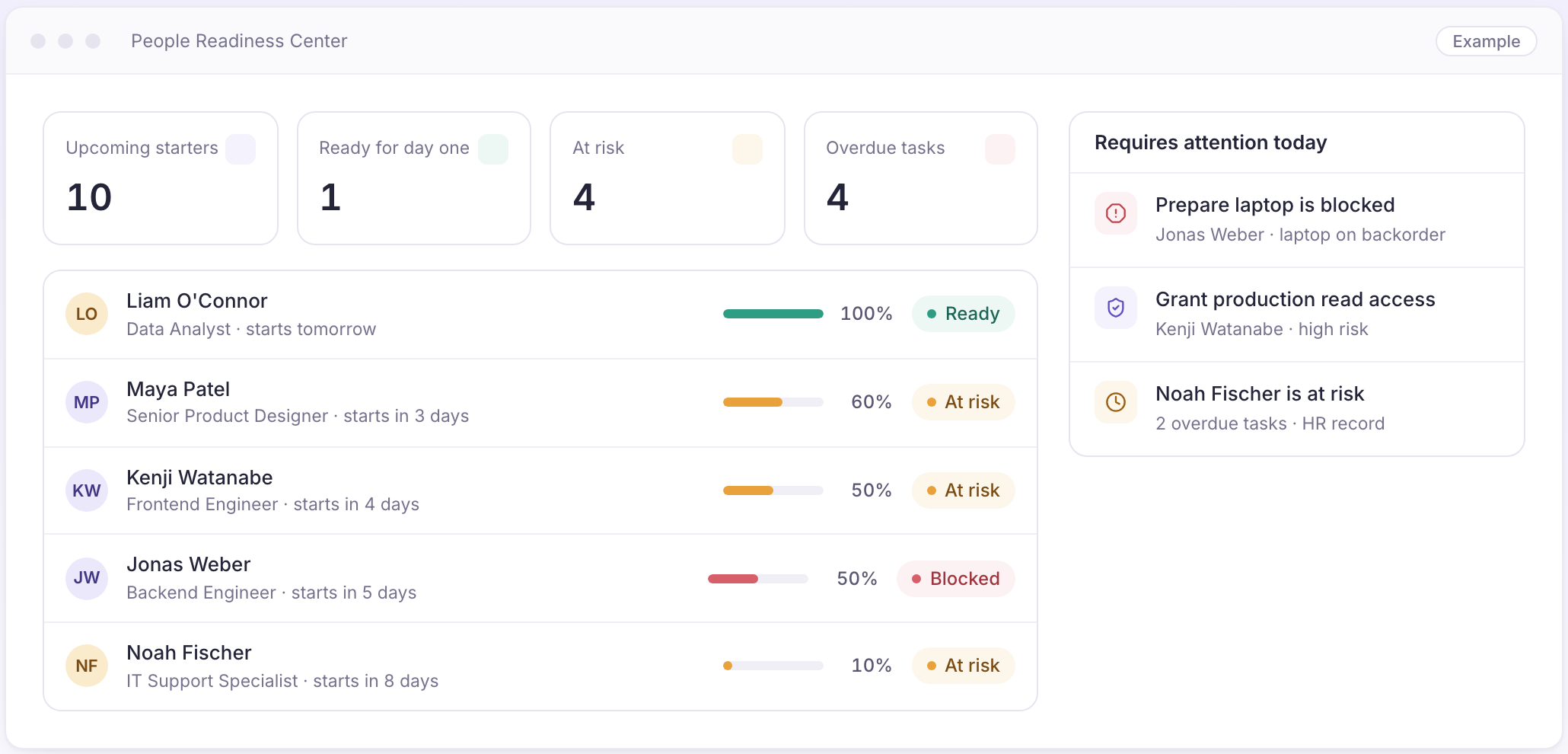
The gap sits between systems, and that's where most late tasks start. Each tool is accurate about its own data, yet none of them will show that a starter's laptop request is still waiting on a manager's approval. That cross-team layer is where  The People Ops Manager fits: it coordinates onboarding and offboarding across HR, IT, finance and hiring managers and shows who's ready for day one and what's blocked. It works alongside your HRIS and doesn't replace one, which is the whole idea. It isn't a new HRIS. If you want to decide which steps to automate first, start with the HR automation guide.
HR Operations FAQ
What is HR operations?
HR operations is the day-to-day execution of HR processes: employee data, onboarding and offboarding, payroll and benefits inputs, time and leave, compliance deadlines and employee service. It makes sure the work happens consistently and on time, whereas HR strategy decides what the company wants from its people.
What does an HR operations person do?
An HR operations person processes hires, changes and exits in the HRIS, keeps employee records accurate, checks that paperwork and filings are complete by their deadlines, answers employee questions about pay, benefits and leave, and follows up with IT, finance and managers on tasks they own.
What is the difference between HR operations and HR administration?
HR administration is the narrower job of maintaining records and forms. HR operations includes administration and also owns the processes around it: who is notified, what happens next, which deadlines apply and what is late. Administration keeps the record right, but operations makes the process run.
What are the main functions of HR operations?
The main functions are employee data management, onboarding and offboarding, payroll inputs, benefits administration, time and leave management, compliance and record retention, and employee service. Larger companies split them across specialists, while smaller ones combine several in one role.
How is HR operations different from people operations?
People operations is a newer name for a function that combines HR operations with employee experience, culture and internal tooling. The two overlap heavily. In practice, a team called people operations typically owns the same processes and also designs more of the employee experience.
What skills do you need for HR operations?
The core skills are accuracy, process discipline, clear written communication, comfort with HRIS and payroll systems, and basic knowledge of employment rules such as Form I-9, FMLA and new hire reporting. Strong candidates also track deadlines and escalate early when something's at risk.