An employee offboarding checklist is a shared plan for ending employment without leaving payroll questions, live accounts, customer commitments, or company equipment behind. It should name an owner for each action, the event that triggers it, a deadline, and the evidence that proves it happened. A list of things to remember isn't enough when HR, IT, payroll, and the departing employee work in different systems. Here's how to build one that doesn't leave gaps, and what you'll want evidence for.
Use the copy-ready checklist below for voluntary resignations, employer-initiated separations, and remote departures. The sequence is designed for US employers, but the legal review must be tailored to the employee's work state, benefit plan, employment terms, and reason for separation. Treat the dates in the example workflow as internal planning targets, not universal legal deadlines.
- Open one offboarding case as soon as the departure is confirmed, with HR as the accountable coordinator.
- Have payroll verify the employee's work-state final-pay rule before anyone promises a payment date.
- Have IT inventory direct and indirect access, then document the exact revocation time and exceptions.
- Transfer business ownership before deleting or changing accounts; preserve records under the applicable retention schedule.
- Close the case only when HR, IT, the manager, payroll, and benefits owners provide evidence, not just a checked box.
Copy-ready employee offboarding checklist
Start with the following master checklist. Duplicate it for each departure and keep confidential employment details in an access-controlled HR system, not in a public team board. A task marked complete should have a timestamp or supporting record. The manager can see operational handoffs without being granted access to private payroll or exit-interview notes.
Exit steps such as the COBRA notice, final pay and record retention are compliance tasks too, and our HR compliance guide covers the thresholds and retention periods.
- HR: confirm the separation type, last day worked, effective employment end date, work state, and approved communication plan.
- HR: create a restricted offboarding case and assign an accountable case owner.
- HR + payroll: verify final-pay timing, earned wages, PTO rules, commissions, expenses, and any authorized deductions.
- Benefits: identify coverage end dates, applicable continuation notices, retirement-plan handoffs, and employee contact details.
- Manager: inventory active projects, customer commitments, approvals, meetings, and documentation needing a new owner.
- IT: inventory SSO, standalone SaaS, privileged accounts, API tokens, MFA methods, VPN, devices, and physical access.
- IT + manager: agree on the revocation trigger and safe transfer of business data before access changes.
- Manager: arrange knowledge-transfer meetings and confirm successor acceptance of each critical handoff.
- HR: plan an optional, appropriately timed exit interview and preserve feedback with restricted access.
- Facilities + IT: arrange equipment, badge, key, and corporate-card return with asset identifiers and receipts.
- IT: disable and verify access, revoke sessions and credentials, and record exceptions and service-owner approvals.
- Payroll + benefits: confirm final payment and applicable notifications with evidence of processing or delivery.
- HR: apply the correct record-retention and legal-hold rules; don't delete the employee's I-9 merely because they left.
- HR case owner: obtain owner sign-offs, record unresolved exceptions, and close the offboarding case.
Recommended tracker columns: Case ID, employee identifier, separation type, work state, effective date, last active work time, task, functional owner, due time with time zone, dependency, status, evidence link, approver, exception, and completed time. Use the case ID rather than the employee's name in shared notifications. Store the full personnel record behind HR permissions.
A useful status vocabulary is Not started, Waiting on another team, Ready to execute, Complete with evidence, and Exception approved. Don't let a task become green merely because someone sent a message asking another team to act. A handoff request and the receiving team's confirmation are different events.
Offboarding timeline with clear owners
The order matters more than a generic calendar. A voluntary departure with notice allows advance knowledge transfer. An immediate termination may require security actions synchronized with the employee notification. The timeline below is an operational default, and each task's legal deadline must be verified separately.
- HR case ownerConfirm separation facts, work state, privacy and communication scope As soon as the departure is confirmed
- Payroll + benefitsDetermine final-pay and coverage obligations; flag time-sensitive items Before the separation meeting or last day
- ManagerIdentify deliverables, customer commitments, and successor owners During notice period, if available
- IT + securityInventory accounts, devices, privileged access, and revocation dependencies Before the access cutover
- HR + managerConduct respectful employee communication and handover At the agreed separation event
- IT + facilitiesDisable access, recover property, preserve business records, and verify exceptions At the approved cutover time
- Payroll + benefitsComplete payments and required notices; log delivery evidence By applicable legal or plan deadlines
- HR case ownerVerify retention, legal holds, approvals, and closure After all obligations and exceptions are resolved
Before the employee's last day
HR owns the trigger. Capture the date employment legally ends separately from the employee's last shift, any paid leave, and the time access should stop. These can differ. The HR owner should also record whether the departure is voluntary, involuntary, retirement, end of a fixed-term arrangement, or a layoff. That classification changes which reviewers need to be involved, but the basic access, pay, and property controls remain.
Payroll owns the pay determination. Ask payroll to document the applicable work-state rule, the final pay period, accrued leave treatment, outstanding commissions or bonuses, approved reimbursements, and the destination for a payment correction. The US Department of Labor explains that federal law doesn't generally require an immediate final paycheck, while some states do. That's why a single companywide promise of "your last check arrives on the next regular payday" can be unsafe. See the Department of Labor's last-paycheck guidance.
Benefits owns the notice path. Confirm whether a group health plan is subject to federal COBRA or another continuation regime, who administers notices, what coverage ends, and whether any dependents are affected. Don't assume an HRIS status change itself constitutes a legally sufficient notice. Record the administrator, date notified, delivery method, and any outstanding response.
The manager owns knowledge transfer. Ask the employee to identify work that would be hard for a replacement to discover: recurring reports, undocumented approval rights, scheduled renewals, vendor contacts, customer promises, data exports, and decisions waiting on an answer. Have a named successor accept each item. A document uploaded to a folder without an owner isn't a completed handoff.
IT owns access discovery. Start from the identity provider, but don't stop there. Standalone logins, admin accounts, delegated inboxes, shared secrets, recovery addresses, cloud infrastructure roles, and personal-device work profiles can survive an SSO disable. Identify business data that must be transferred lawfully before accounts are deleted. Confirm retention or litigation-hold instructions with HR or legal before purging anything.
On the last working day or at the separation event
Coordinate the employee conversation, payment instructions, equipment return, and access changes from one approved cutover plan. For an immediate termination, IT may need to be ready to act during the meeting. For a planned resignation, keep access available only as long as the employee needs it for authorized handoff work, then remove it at the approved time.
Disabling the identity account isn't the same as proving access is gone. The IT closer should test or inspect the relevant systems, revoke active sessions and tokens where supported, remove privileged roles, and verify physical access. NIST's personnel-termination control PS-4 addresses disabling access, revoking credentials, recovering security-related property, and preserving organizational access to information. NIST leaves the specific disablement period for the organization to define; there's no universal statutory deadline. See NIST SP 800-53 PS-4.
Have the manager confirm that ownership transfers actually worked: can the successor access the needed project folder, accept a pending approval, view the customer history, and receive the recurring report? The exit isn't operationally complete if the departing person's access is gone but the replacement can't continue the work.
After the departure
Close payment and benefits actions on their verified deadlines, not on the arbitrary date the HR ticket was created. Update distribution lists, organization charts, recurring meetings, customer contacts, emergency escalations, and any signatory or approval routing. Make sure the employee has a safe channel to ask about tax forms, pay corrections, or benefit notices after their company email is disabled.
Reconcile the asset register with returned devices, badges, keys, credit cards, and peripherals. For unreturned items, create an exception with a responsible owner and follow-up date. Don't silently mark the item returned, and don't assume the company can automatically deduct its value from final wages. Payroll or legal should determine what is permitted.
The HR, IT, payroll, and manager handoff matrix
An offboarding process usually fails at the seam between teams. The table below defines the receiving team's evidence, which is more useful than another long list of generic responsibilities.
| Workstream | Accountable owner | Trigger or input | Evidence required to close |
|---|---|---|---|
| Separation record | HR | Confirmed departure | Approved effective date, work state, separation classification |
| Final compensation | Payroll | Approved separation record | Reviewed final-pay calculation, due date, processing confirmation |
| Benefits transition | Benefits administrator | Loss of coverage or qualifying event | Eligibility review, notice owner, dispatch or completion record |
| Knowledge transfer | Hiring manager | Confirmed last active day | Named successor and acceptance of active commitments |
| Identity and SaaS | IT or security | Approved access cutover | Revocation log, account inventory, exceptions |
| Business data | IT + manager | Transfer plan and retention instruction | New file or mailbox owner, verified access |
| Equipment and badges | IT + facilities | Asset assignment list | Returned item IDs or approved recovery exception |
| Records and closure | HR + legal as needed | Functional owner confirmations | Retention classification, legal-hold check, case sign-off |
Practical example: A departing sales operations analyst owns a scheduled revenue report and the only admin login to a small reporting tool. HR can complete the employee record, payroll can issue the final pay, and IT can disable the analyst's SSO, yet the report still fails next week. The missing tasks are to identify the tool's standalone admin credential, nominate a service owner, migrate the schedule, and run the report under the replacement account before disabling the old one. That's why "revoke access" and "retain business continuity" belong in the same checklist.
How to run a secure IT offboarding checklist
The most useful IT sequence separates discovery, cutover, and verification. It also distinguishes employee identity from company data. Losing a person's credentials mustn't mean losing the only copy of a customer record or the credentials for a shared production integration.
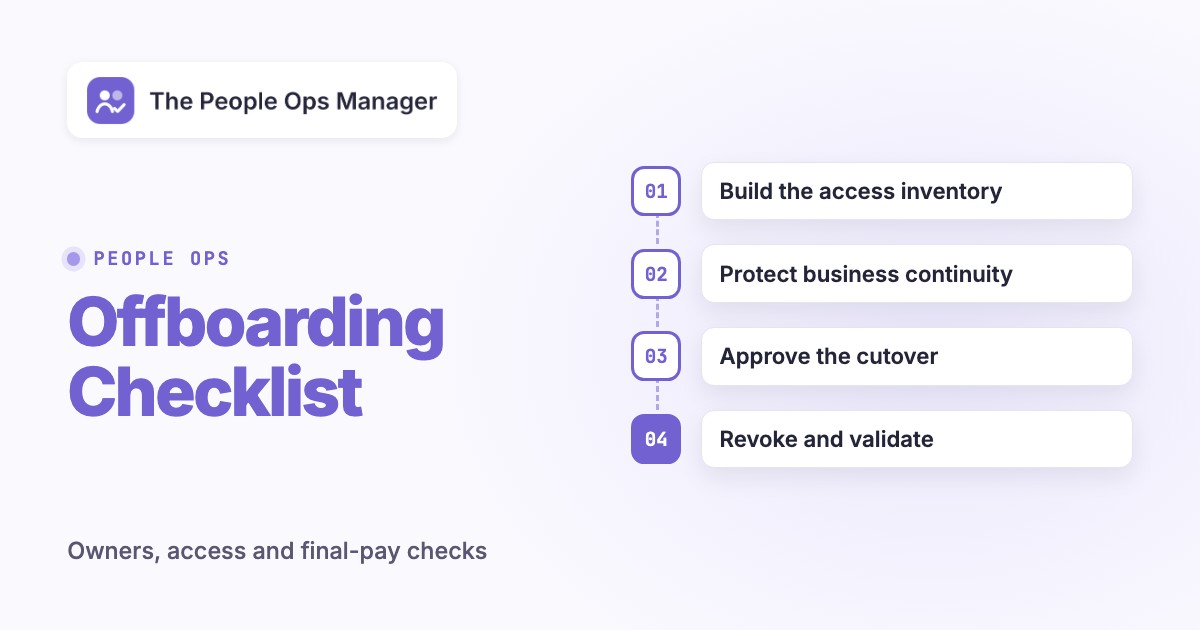
Build the access inventory
Export the identity-provider memberships and add standalone applications, cloud roles, delegated access, service credentials, VPN, physical access, and personal-device work profiles. Assign a verifier to each critical system.
Protect business continuity
Identify shared files, calendars, scheduled jobs, automations, customer relationships, and approvals that need reassignment. Confirm legal holds and retention before transferring or deleting content.
Approve the cutover
HR confirms the exact separation event and authorized revocation time. Security flags privileged access or immediate-risk situations. Record any approved temporary exception and its expiration.
Revoke and validate
Disable accounts, invalidate active sessions where supported, revoke tokens and MFA methods, rotate shared secrets where appropriate, and test that access no longer works. Remove badges and facility credentials.
Document the residual risk
Attach logs or screenshots, record unreturned devices and unmanaged apps, and assign owners to any exception. Don't close the case until each exception is explicitly accepted or resolved.
A useful acceptance test is: If this person tried to sign in after the approved cutover, which systems could still accept them? Don't assume the answer is "none" until the team has checked the exceptions. Examples include locally provisioned vendor accounts, API keys embedded in scripts, delegated permissions in a shared mailbox, and a contractor's access granted by a customer rather than your own IT team.
For remote workers, arrange a shipping label or approved pickup and keep the tracking number attached to the asset record. Record serial numbers and condition on return. When devices can't be recovered promptly, IT should use only approved device-management actions and coordinate with legal and privacy stakeholders before remote wiping. Personal devices need special care because company and personal data can coexist.
US offboarding compliance: what the checklist mustn't guess
A good template distinguishes operational best practices from legal obligations. The following examples are national reference points, not a complete state-law or plan review. HR and payroll should verify applicable rules for the specific employee and organization.
Final paycheck and PTO
The US Department of Labor states that federal law doesn't generally require an immediate final paycheck, but some states require prompt payment. Ask payroll to document the rule that actually applies to the employee's work state and separation type. Accrued vacation, commissions, severance, and deductions require separate checks against state law, contracts, and company policy. A payroll system calculating an amount doesn't establish that the due date is lawful.
Control to add: A required "final-pay jurisdiction checked" field with reviewer, source, determination, and due date. Block case closure if the calculation is complete but the payment or delivery confirmation is missing.
COBRA and benefits notices
Where federal COBRA applies, the Department of Labor's employer guide explains that employers generally notify the plan within 30 days of a termination or reduction in hours that's a qualifying event. The plan administrator generally provides the election notice within 14 days after receiving the event notice. Plan structure and special rules can change who sends what, so the checklist must identify the actual notice owner. Don't copy these deadlines into every separation without an applicability review.
Control to add: Plan name, eligibility determination, administrator contact, event date, notification due date, date sent, and proof of delivery. If a person isn't eligible for a particular federal program, document why and check whether a state continuation requirement applies.
Form I-9 and other record retention
An employee's departure doesn't mean HR should delete their Form I-9. USCIS guidance describes a retention period of three years after hire or one year after employment ends, whichever is later. Keep the record while the person remains employed, and calculate the later date only after separation. Confirm the current USCIS I-9 guidance and any legal hold before scheduling destruction.
The EEOC's recordkeeping guidance states that covered employers generally retain personnel or employment records for one year, with a specific rule for involuntary terminations measured from termination. Different payroll, benefits, and litigation-hold requirements can demand longer preservation. Don't use the I-9 period as the universal retention rule for every employee document.
Control to add: A retention category for each record type, its source rule, any legal hold, and the earliest approved disposition date. Access restrictions should continue after employment ends. Preserve exit-interview notes and sensitive separation documents only in appropriately restricted locations.
Year-end tax forms and post-exit contact
The IRS's 2026 instructions for Forms W-2 and W-3 address year-end furnishing requirements and an accelerated response when a former employee requests a Form W-2. Payroll should keep a reliable personal mailing address or approved electronic-delivery consent and make clear how the former employee can request a correction. A disabled work inbox isn't a usable delivery channel.
Adapt the checklist to the type of departure
Voluntary resignation with notice: Prioritize knowledge transfer, documentation, customer communication, and a respectful exit experience. Schedule the cutover to avoid disrupting legitimate handoff work. Don't postpone access revocation simply because the person left on good terms.
Involuntary termination: Coordinate HR, legal, security, payroll, and facilities before the notification. Determine whether the person should keep any access during the conversation, how to return belongings, and who'll communicate with the team. Use a controlled, need-to-know process rather than an open shared calendar event.
Layoff or reduction in force: Add a review of group-separation notices, applicable agreements, benefit coverage, selection documentation, and any jurisdiction-specific obligations. Legal should assess the situation before HR assumes the ordinary single-employee workflow is enough.
Remote employee: Confirm return shipping, asset identifiers, device-management authority, personal-device work data, time zones, and the destination for final documents. Give the former employee a personal contact method for questions after their work email closes.
Contractor or agency worker: Verify who is the legal employer, which party owns the accounts and equipment, and what the contract says about termination and data return. A contractor exit can still require access revocation and handover even when employee payroll or benefit tasks don't apply.
Privileged administrator or executive: Review signing authority, payment approvals, banking access, secrets, domain registrars, vendor ownership, board permissions, and delegated access. Arrange an independent second reviewer. The checklist shouldn't expose security credentials to the broader HR team.
A worked example: remote employee resignation
Imagine a remote customer operations specialist resigns while owning a shared inbox, a weekly customer report, and a vendor dashboard. The manager confirms the last active shift and chooses a successor. HR opens a restricted case, payroll checks the work-state final-pay rule, and benefits identifies the coverage-notice owner.
Before the last shift, IT inventories the identity account, the vendor dashboard's local login, the shared inbox delegation, and the laptop asset tag. The successor tests access to the report and inbox. The employee documents unresolved customer issues and the next contact for each account. The manager signs off on the transfer, rather than assuming a meeting invitation proves it happened.
At the agreed cutover, IT disables the identity account, revokes the standalone vendor login, removes delegated mailbox access, checks active sessions, and logs the results. The laptop's shipped with tracking and remains an open asset task until receipt is confirmed. Payroll and benefits close their own tasks on their verified schedules. HR keeps the case open until the outstanding equipment item has a recorded outcome.
The point of this example isn't the number of tasks. It's the dependency: IT can't safely delete the old reporting identity before the successor has a working report, and HR can't claim the case is fully closed while a device or notice remains unresolved.
What to automate and what to keep under human review
Automation's useful for creating the case, assigning owners, calculating internal due dates, notifying the receiving team, and checking whether a response arrived. A workflow can also compare an identity inventory with the revocation confirmations and flag an exception for human follow-up.
Keep decisions about legal classification, final-pay interpretation, benefit eligibility, high-risk account deletion, legal holds, and sensitive employee communications under appropriate human review. The goal isn't to remove approvals; it's to keep them honest. It's to make missing approvals visible before the last day.
If your HR system, IT ticket queue, payroll platform, and asset register are separate, make the offboarding case the shared coordination layer. It should link to the source record rather than copy confidential payroll details into another tool. Our own product, The People Ops Manager, is built for this coordination layer. It isn't a payroll system or an HRIS, and it doesn't replace identity deprovisioning in your IT stack.
How to measure whether offboarding actually works
Track the process at the handoff level, not just the number of cases closed. Useful internal metrics include:
- Access-revocation lag: Time between the approved cutover and the last confirmed removal of access. Report the slowest critical system, not just the average.
- Unowned handoffs: Active customer, project, approval, or recurring-task items with no confirmed successor at the cutover.
- Overdue legal or plan tasks: Final-pay and benefits items that miss their verified, applicable deadlines. Keep these separate from optional internal targets.
- Asset recovery exceptions: Assigned equipment still outstanding after the agreed return window, with a responsible follow-up owner.
- Reopened cases: Departures reopened because a system login, payment correction, or missing record was discovered later.
Review a small sample of closed cases regularly. Ask whether the evidence would let an independent reviewer reconstruct who approved the departure, when access ended, which business responsibilities moved, and how the employee received their final information. If not, improve the checklist before buying another automation tool.
Common offboarding mistakes and how to avoid them
Mistake: A universal "last day" deadline. The last shift, legal employment end, benefits loss date, final pay due date, and access cutover can differ. Record them separately and let the correct owner verify each.
Mistake: Disabling SSO and declaring victory. An SSO event doesn't necessarily revoke standalone accounts, sessions, shared secrets, or physical badges. Maintain an inventory and test critical systems after cutover.
Mistake: Deleting a mailbox before ownership transfers. Preserve business records according to policy and legal holds, reassign customer conversations, and validate successor access before any deletion.
Mistake: Treating every exit like a resignation. An immediate termination may need a synchronized security plan; a layoff can introduce legal review; a contractor exit may involve another employer. Branch the workflow by situation.
Mistake: Putting private HR details in a shared board. Use a restricted case with role-based visibility. Managers need handoff status, not confidential payroll, medical, or investigation notes.
Mistake: Closing tasks on request rather than completion. "IT notified" isn't "access revoked." "Benefits team emailed" isn't proof that a required notice was issued. Require receiving-team confirmation and evidence.
Employee offboarding checklist FAQs
What should an employee offboarding checklist include?
Include separation details, final pay, benefits, access revocation, company property, knowledge transfer, employee communication, record retention, and a documented closeout. Each task needs an owner, deadline, and completion evidence.
When should the offboarding process start?
Open the case as soon as the departure is confirmed. For an immediate termination, coordinate the HR, security, payroll, and facilities actions before the notification when possible. For a planned resignation, begin handoffs during the notice period.
Who's responsible for employee offboarding?
HR usually coordinates the overall case. Payroll owns wage calculations, benefits owns plan notices, IT and security own account revocation, facilities tracks property, and the manager owns business continuity. Name a specific accountable person for each task.
Should IT revoke access before or after the exit interview?
Use a risk-based cutover approved by HR and security. An immediate termination may require revocation synchronized with notification. A voluntary departure may retain authorized access until the last active work period ends. Verify the result and document exceptions.
How long should an employer retain Form I-9 after termination?
USCIS guidance describes the later of three years after hire or one year after employment ends. Don't destroy an I-9 for a current employee, and confirm the current rule plus any legal hold before scheduling disposal.
Can an HR checklist replace a payroll or identity-management system?
No. A checklist coordinates owners and evidence. Payroll must determine and process lawful pay, while identity and IT tools must actually revoke accounts and credentials. The checklist should link to proof from those systems.
The practical offboarding standard
The best employee offboarding checklist isn't the longest one. It's the one that makes ownership explicit, sequences actions safely, respects the employee's final experience, and gives the business a reliable record of what happened. Start with the template, adjust it for the employee's work state and departure type, and require receiving-team proof before closing the case.
For the reverse process, see our employee onboarding checklist and new hire onboarding template. The same ownership discipline that prevents day-one onboarding gaps can prevent lingering access and unassigned work when someone leaves.