An employee handbook template is a ready-made outline of the sections, policies and sample wording that a company turns into its own handbook. A good one gives you the structure (welcome, employment basics, conduct, pay and leave, reporting routes, acknowledgment), so you don't start from a blank page and can spend your time on what only your company can write: what your rules are, who owns them and what happens when someone breaks one.
This page gives you a free template you can copy or download as a Word file or a spreadsheet, sample wording for the clauses people most often get wrong, and the short list of US legal points that change how you write the document. You won't find a 40-page policy dump here, because a handbook that's too long doesn't get read. It's written for HR and People Ops teams at US companies. It isn't legal advice, and state and local rules differ, so have an employment lawyer read the final version before you hand it to employees.
- Use seven sections: welcome, employment basics, workplace policies, conduct and reporting, pay and time off, leaving the company, and an acknowledgment of receipt.
- Write each policy as a rule, an owner and a place to ask questions. Put the detail in the policy itself and keep the handbook short.
- If you have a handbook and an FMLA-covered workforce, the federal FMLA notice has to be in it, or be given to each new hire.
- State that the handbook isn't a contract and that employment is at will only if that's true where you operate, and have counsel confirm the wording.
- Collect a signed or electronic acknowledgment, store it, and re-issue the handbook whenever a policy changes.
What Should an Employee Handbook Template Include?
A complete employee handbook template includes seven parts: a welcome and company overview, employment basics, workplace policies, a code of conduct with reporting routes, pay, benefits and time off, a section on leaving the company, and an acknowledgment of receipt. The same core list shows up across the handbook guides ranking for this query, so use it as the skeleton and add only what your business needs.
The table below shows what each part is for and the question it should answer for an employee. Anything marked "if it applies" belongs in the handbook only when it's true for your company.
| Handbook section | What it answers | Typical contents |
|---|---|---|
| Welcome and overview | Who are we and what does this document do? | Mission, values, handbook purpose, who it covers, version date |
| Employment basics | How do I work here day to day? | Employment categories, schedules, attendance, pay dates, time recording, remote or hybrid rules |
| Workplace policies | What are the ground rules? | Equal opportunity, anti-harassment, safety, technology and data use, confidentiality |
| Conduct and reporting | How do I raise a problem? | Code of conduct, reporting routes, anti-retaliation, discipline, investigation steps |
| Pay, benefits and time off | What do I get and how do I use it? | Pay practices, benefits summary, paid time off, holidays, leave, expense rules |
| Leaving the company | What happens when I go? | Resignation steps, final pay timing, return of equipment, benefits continuation |
| Acknowledgment | How do you know I received this? | Signed or electronic receipt, at-will and no-contract statement (if it applies) |
Two points keep the document usable, and neither is about length. First, a handbook summarizes policies and points to the detailed source, so a three-page leave policy shouldn't be pasted into it. The handbook tells people what to expect, while the policy tells them exactly what to do. Second, every section needs a named owner on your side, because a policy without an owner is the one that's out of date in a year. If your onboarding checklist already assigns HR, IT and managers to tasks, the same owners usually fit here, and our employee onboarding checklist shows how to record who is accountable for what.
Free Employee Handbook Template You Can Copy or Download
Copy the template below into your own document, or download the Word file for the full text or the spreadsheet for tracking sections, owners and review dates. Grey example values show what a finished entry looks like; replace them with your own. Nothing is gated and there's no sign-up, so you can try it before you decide whether to adapt it.
Employee handbook template
Seven sections for a US employer. Replace the grey examples, delete anything that doesn't apply to you and have counsel review the result.
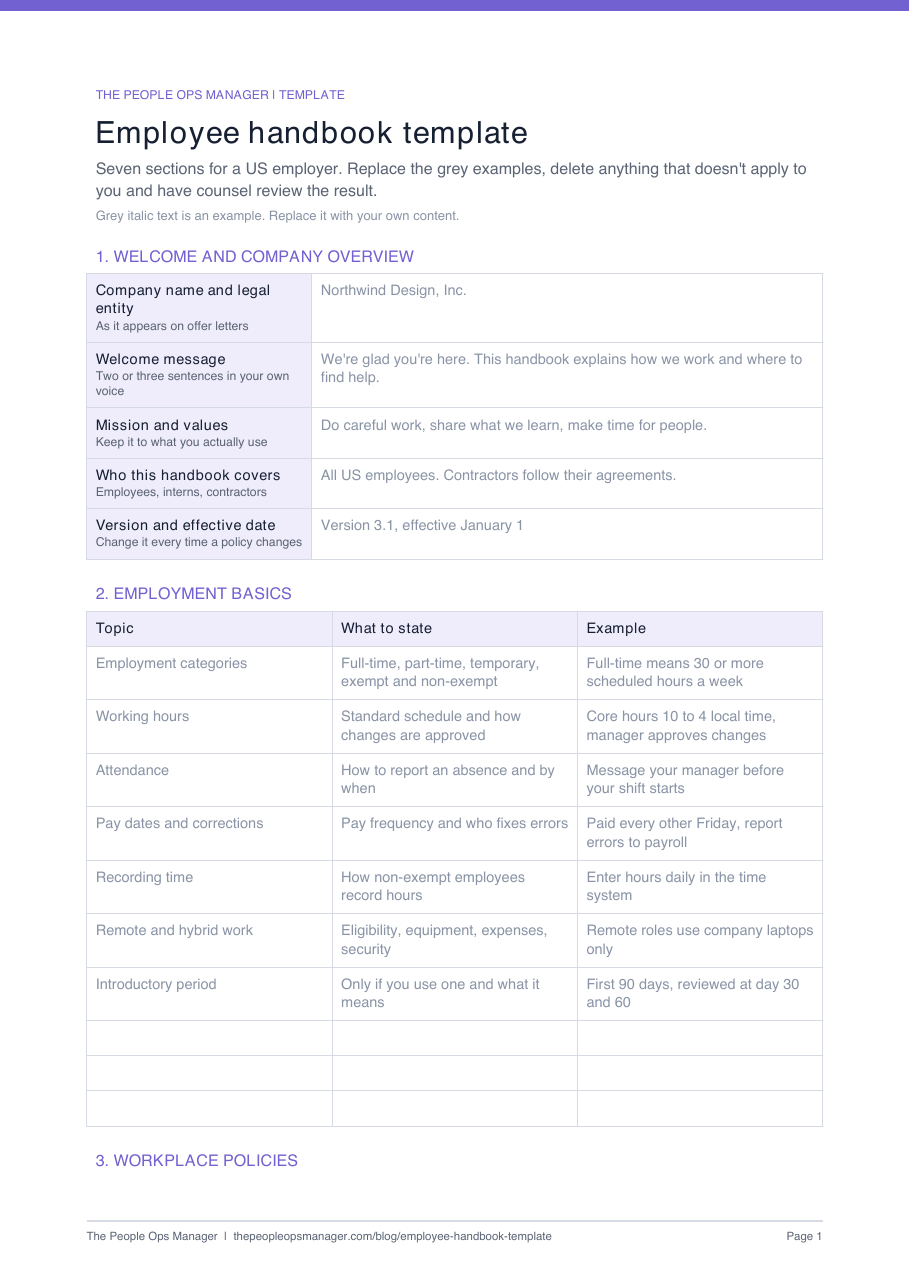
- Company name and legal entity
- Northwind Design, Inc.As it appears on offer letters
- Welcome message
- We're glad you're here. This handbook explains how we work and where to find help.Two or three sentences in your own voice
- Mission and values
- Do careful work, share what we learn, make time for people.Keep it to what you actually use
- Who this handbook covers
- All US employees. Contractors follow their agreements.Employees, interns, contractors
- Version and effective date
- Version 3.1, effective January 1Change it every time a policy changes
| Topic | What to state | Example |
|---|---|---|
| Employment categories | Full-time, part-time, temporary, exempt and non-exempt | Full-time means 30 or more scheduled hours a week |
| Working hours | Standard schedule and how changes are approved | Core hours 10 to 4 local time, manager approves changes |
| Attendance | How to report an absence and by when | Message your manager before your shift starts |
| Pay dates and corrections | Pay frequency and who fixes errors | Paid every other Friday, report errors to payroll |
| Recording time | How non-exempt employees record hours | Enter hours daily in the time system |
| Remote and hybrid work | Eligibility, equipment, expenses, security | Remote roles use company laptops only |
| Introductory period | Only if you use one and what it means | First 90 days, reviewed at day 30 and 60 |
- Equal employment opportunity statementName the protected categories that apply in your states
- Anti-harassment and anti-discrimination policyDefinition, examples, how to report, no retaliation
- Health and safety, injury reportingWho to tell and how fast
- Reasonable accommodation processDisability, religion, pregnancy; who handles requests
- Technology, data and acceptable useDevices, accounts, monitoring notice if you monitor
- Confidential informationKeep it narrow so it doesn't read as a ban on discussing pay
- Social media and public statementsWho speaks for the company
- Code of conduct
- Treat colleagues and customers with respect. No threats or bullying.Specific behaviors, not adjectives
- How to raise a concern
- Your manager, any HR team member or the People Ops mailboxAt least two routes, one outside the chain of command
- No retaliation
- We don't tolerate retaliation against anyone who raises a concern in good faith.Applies to people who report and who take part in an investigation
- What happens after a report
- HR contacts you within 3 business days and explains next steps.Who looks into it and what the employee will hear
- Discipline
- Steps may include coaching, a written warning or termination.Describe the range without promising a fixed process
| Topic | Who is eligible | Where the detail lives |
|---|---|---|
| Benefits summary | Employees working 30 or more hours | Benefits portal and plan documents |
| Paid time off | All employees, accrued each pay period | PTO policy |
| Company holidays | All employees | Holiday calendar on the intranet |
| Family and medical leave | Eligible employees under federal and state law | Leave policy and the federal FMLA notice |
| Other leave | Jury duty, military, bereavement, as your policy states | Leave policy |
| Expense reimbursement | Employees with approved business expenses | Expense policy, submit within 30 days |
- Resignation: how to give notice and who to tell
- Final pay: when it is issued under your state's rule
- Return of laptop, badge and other company property
- Access removal date and handover of work
- Benefits continuation information and exit conversation
- Employee name
- Jordan Rivera
- Date received
- 2027-01-04YYYY-MM-DD
- Statement
- I received the Employee Handbook, I understand I should read it and I know where to ask questions.Receipt and where to find updates
- Handbook status statement
- This handbook is a guide, not a contract, and the company may change it.Only if accurate for your company and approved by counsel
- Signature and date
- Signed or recorded electronically
What Does Sample Employee Handbook Language Look Like?
Sample employee handbook language is plain, specific and short: it says what the rule is, who it applies to and where to ask a question. The three samples below cover the clauses that cause the most trouble, which are the welcome that sets the tone, the statement about what the handbook is and isn't, and the receipt form. Adapt the wording, and have counsel check each one against your state's law.
You may not want an "at will" sentence in the second sample, and whether to add one depends on where you operate. Most US states treat employment as at will by default, and some states or contracts change that, so put the sentence in only after counsel confirms it fits. The closing line about discussing pay is there for a reason covered in the next section.
Which Employee Handbook Policies Does US Law Require?
The US has no general federal law that requires an employer to publish an employee handbook. What the law does require is that certain notices and policies exist and that employees can get to them. A handbook isn't mandatory, but it's the usual place to put them. State and local rules add more, so treat this section as a map of the federal points that most often change the draft, not as a full list.
| Topic | What the source says | Source |
|---|---|---|
| FMLA general notice | An FMLA-covered employer with eligible employees gives the general notice by putting it in its employee handbook or other written guidance on benefits or leave, or by giving a copy to each new hire. Electronic delivery counts. | 29 CFR 825.300 |
| Who is covered by FMLA | Private employers with 50 or more employees in 20 or more workweeks in the current or previous calendar year. Eligible employees have 12 months of service, 1,250 hours worked in the prior 12 months and a worksite with 50 employees within 75 miles. | US Department of Labor |
| Harassment policy and complaint process | The EEOC advises a clear, easy-to-understand policy, more than one way to report, training for all employees and a check that the policy is applied consistently. | EEOC small business fact sheet |
| Work rules and employee rights | The NLRB replaced its earlier test for handbook rules with the Stericycle test on August 2, 2023. The test looks at whether a rule could reasonably discourage employees from discussing pay or working conditions. | NLRB news story |
Two things follow from the table. If you employ 50 or more people, the FMLA notice belongs in the handbook, or must reach each new hire another way, and your leave section should point to your actual FMLA process. And broad rules such as "never discuss company matters" or "all information about pay is confidential" are the kind of wording the NLRB scrutinizes, which is why the sample above ends with a rights statement and why the template asks you to keep the confidentiality policy narrow.
The NLRB's test has changed before and could change again with the Board's membership, so check its current guidance when you review the handbook. Local rules matter too: paid sick leave, final pay timing, lactation breaks and required notices vary by state and city, so a company with employees in several states often needs a state addendum rather than one text for everyone.
How Do You Build an Employee Handbook From a Template?
Build the handbook in five steps: collect what exists, fill the template, get legal and leadership review, roll it out with a signed receipt, and schedule the next review. Each step has one owner, which keeps the work from stalling in a shared document that everyone can edit and nobody finishes. Plan about four to six weeks from the first draft to the rollout, depending on how many policies already exist.
Gather existing policies
Pull current offer-letter terms, leave and PTO rules, expense policy, IT acceptable use and any past complaint procedure into one folder. Note which are out of date or only exist as habits.
Fill in the template
Write each section in your own voice, one rule per paragraph. Where a policy already has its own document, summarize it in two or three lines and link to it.
Review with counsel and leadership
Ask an employment lawyer to review the state-specific parts, the at-will and no-contract wording, leave policies and anything about confidentiality or social media. Resolve conflicts between what the handbook says and what managers actually do.
Roll it out and collect receipts
Send the handbook with a short note on what is new. Brief managers first so they can answer questions, then record each employee's acknowledgment in your HR system or onboarding tracker.
Schedule review dates
Put a yearly review on the calendar and name a person who owns each section. Decide in advance what triggers an earlier update, such as a new state, a law change or a new benefit.
Step four is where handbooks often fail quietly, because nobody's job is to chase the last signatures. If acknowledgments live in an email thread, nobody can answer "who hasn't signed?" when an employee relations issue comes up, and that's exactly when you'll be asked. Treat the receipt as an onboarding task, not a side errand, with an owner, a due date and proof of completion. The new hire onboarding template shows where a handbook receipt fits in the first week.
Should You Use Word, PDF, Google Docs or Handbook Software?
Use a Word or Google Docs master for drafting and a PDF or intranet page for employees to read. Handbook software helps once you have several locations, frequent policy changes or a need to prove who has read which version. A small team with one location and a yearly review usually doesn't need it, but a company that can't say who signed which version does.
| Format | Best for | Watch out for |
|---|---|---|
| Word or Google Docs | Drafting, redlines and legal review | Version sprawl when copies circulate by email |
| A fixed, readable copy for employees | Hard to update; old copies stay in inboxes | |
| Intranet or wiki page | Searchable policies with links to detail | Needs a named owner and a change history |
| Handbook or policy software | Many locations, versions and tracked acknowledgments | Cost and setup time; you still write the policies |
| Spreadsheet tracker | Tracking owners, review dates and receipts | Not a place to publish policies to employees |
Can ChatGPT Write an Employee Handbook?
ChatGPT and other AI assistants can produce a first draft of a section or tighten wording, but it can't know your states, your headcount or your actual practices, and it'll state a rule with confidence even when the rule is wrong for your location. Use it for structure and plain-language edits rather than legal conclusions, don't paste confidential employee data into it, and send anything it drafts through the same legal review as a human draft. The review is the step that makes a handbook safe to issue, not a formality.
How Do You Roll Out the Handbook and Track Acknowledgments?
Roll out the handbook through managers first, then to all employees, and record a receipt for each person. For new hires, include it in the first-week tasks so the acknowledgment is a normal part of onboarding rather than a separate chase.
- HRFinalize the handbook after legal review and freeze the version number. Proof: approved version in the document system. Week 1
- HRBrief managers on what changed and how to answer common questions. Proof: attendance list. Week 2
- HRPublish the handbook and send the acknowledgment request with a due date. Proof: sent message and tracking list. Week 3
- ManagerRemind team members who haven't acknowledged and answer questions. Proof: updated tracking list. Week 4
- HRStore receipts, follow up on gaps and note exceptions such as employees on leave. Proof: complete receipt record. Week 5
- HRAdd the handbook receipt to the new-hire task list. Proof: task template updated. Week 5
Employees who are on leave when the handbook goes out still need a copy, so give them a date for the receipt when they're back instead of skipping them. A receipt doesn't prove an employee understood every rule, so training for managers and clear contacts matter as much as the signature.
How Often Should You Update Your Employee Handbook?
Review the whole handbook at least once a year and update it sooner whenever a policy, a law or your workforce changes. A yearly date is a practical habit rather than a legal deadline; it's not a rule, and it keeps the version number honest.
- You hired in a new state or country
- A state or local law changed a leave, pay or notice rule
- You changed benefits, PTO or the remote work policy
- A complaint or investigation showed a policy is unclear
- You added a new tool that changes data or acceptable use rules
- Headcount crossed a legal threshold, such as 50 employees for FMLA
When you update, change the version date, list what changed in a short summary and ask for a new acknowledgment on the policies that changed. Keep old versions archived with their dates so you can show which rules applied when.
What Mistakes Make an Employee Handbook Hard to Defend?
The most common mistakes are copying a template without removing what doesn't apply, writing rules nobody enforces and leaving the document unreviewed for years. Each one makes the handbook either confusing or a record of promises the company doesn't keep.
- Promising a process you don't follow. A step-by-step discipline policy that managers skip is worse than a flexible one they actually follow.
- Leaving in rules from another state or country. Delete anything that doesn't fit your locations rather than hoping nobody asks.
- Vague conduct language. "Professional behavior" means different things to different managers; list the behaviors you mean.
- No second reporting route. If the only option is the employee's manager and the manager is the problem, the policy fails the people it's meant for.
- Overbroad confidentiality or social media rules. Narrow them, and add a rights statement like the one above.
- No owner and no version history. If nobody owns a section, nobody updates it.
Employee Handbook Template FAQ
What should an employee handbook include?
An employee handbook should include a welcome and company overview, employment basics, workplace policies such as equal opportunity and anti-harassment, a code of conduct with reporting routes, pay, benefits and time off, a section on leaving the company, and an acknowledgment of receipt. Add only what applies to your company.
Is an employee handbook required by law?
No general federal law requires a handbook. Certain notices and policies are required, though, and a handbook is the usual place for them. For example, an FMLA-covered employer with eligible employees must give the FMLA general notice by including it in its handbook or other written guidance, or by giving a copy to each new hire. State and local rules add more.
How often should an employee handbook be updated?
Review it at least once a year and update it sooner when a policy, law or workforce change affects it. Change the version date each time and ask employees to acknowledge changes to policies that matter.
What is the difference between an employee handbook and HR policies?
The handbook is the short overview that tells employees what to expect and where to look. Individual HR policies hold the detailed rules and procedures, such as the full leave policy, and the handbook summarizes them and links to the current version.
Should employees sign an acknowledgment of receipt?
Employees should sign an acknowledgment of receipt, and it's a good practice. A signed or electronic receipt shows that the employee received the handbook and knew where to find updates. It doesn't prove the employee understood every rule, so pair it with manager training and clear contacts.
Can ChatGPT write an employee handbook?
ChatGPT can draft a first version of a section or improve plain-language wording, but it doesn't know your states, headcount or practices and can state wrong rules confidently. Treat its output as a draft and have an employment lawyer review it before you issue it.