Deel is a strong candidate when one People Ops team has to hire, pay and manage workers in several countries and wants one vendor to own the legal and payroll mechanics. It's a weaker fit when you employ people in one country through your own entity and only need domestic payroll. The decision turns on which worker types you have and which countries they live in, not on how long the feature list is.
This Deel review covers the employer of record service, contractor management, payroll, the HR and IT add-ons, security, support, pricing and customer feedback. We read Deel's product pages, help center and public review data, and we haven't run a paid account, so every product statement below comes from what Deel and its customers say publicly. Where Deel's own pages disagree, we say so.
- Best fit: companies hiring across borders that need employer of record, contractor and payroll services from one vendor.
- Key advantage: one platform covers employees, contractors and EOR workers, with payroll in 150+ countries and payments in 120+ currencies.
- Key tradeoff: the monthly service fee is only part of the bill, because EOR deposits, employer liability cost and severance accruals sit on top.
- Before buying: get a written country quote and test one hire, one contractor payment and one correction.
Our verdict: who should choose Deel?
Choose Deel if you hire in countries where you've no legal entity. Its employer of record service lets Deel employ the worker locally while you manage the day-to-day work. For a team that would otherwise open an entity per country, that's the main reason to shortlist it.
Choose Deel if you manage a mix of employees and contractors. Contractor management, Contractor of Record, EOR and payroll sit in the same platform, so a worker who moves from contractor to employee doesn't force a switch of vendors. Deel says contractors can be converted to employees in 110+ countries.
Look elsewhere if your need is narrow. A company with one US entity and a domestic workforce can compare a US payroll and HR suite such as the one in our Rippling review or the Gusto review before paying for global coverage it won't use.
| Buyer situation | Deel fit | Why |
|---|---|---|
| First hires in several countries, no local entities | Strong | EOR removes the need to set up an employing entity first. |
| Contractors and employees in the same countries | Strong | Both worker types and their payments share one platform. |
| Existing entities in many countries, needing payroll only | Conditional | Global Payroll applies, but compare it with local providers on price and support. |
| One-country US team with simple payroll | Weak | A domestic payroll suite is usually simpler and cheaper to own. |
| Very large enterprise with entrenched HRIS | Conditional | Check integrations and migration effort before assuming a clean switch. |
What is Deel and what does it do?
Deel is a global hiring, payroll and HR platform that lets companies employ and pay workers in other countries without building the legal and payroll setup themselves. Its core services are employer of record (EOR), contractor management, Contractor of Record, global payroll and US payroll. Around them sit HR software, equipment procurement, immigration support and a US PEO.
| Deel service | What it covers | Starting price (USD) | Who carries the main risk |
|---|---|---|---|
| Employer of record | Local employment, payroll and benefits without your own entity | $599 per employee per month | Deel is the legal employer, and you fund the invoice |
| Contractor Management | Agreements, invoices and payments for independent workers | $49 per contractor per month | Your company owns classification |
| Contractor of Record | Deel contracts with the worker as agent of record | $325 per contractor per month | Deel says it takes on liability and indemnification |
| US PEO | US co-employment, benefits and HR administration | $125 per employee per month | Shared between you and Deel under the order form |
| Global Payroll and US payroll | Pay runs for employees, contractors and EOR workers | Quote needed, no price on the product pages | You're the employer, so you approve each run |
Prices are the starting rates on Deel's pricing page, checked November 14, 2026.
The practical value is that each service answers a different legal question. EOR answers who employs a person in a country where you've no entity. Contractor Management answers how to contract and pay an independent worker. Payroll answers how to run pay for people you already employ through your own entity. The platform's job is to keep those answers consistent when you hire the next person in the next country.
Deel says more than 40,000 companies use it. That figure comes from its own site, so it's a vendor claim and not an audited number.
How does Deel's employer of record service work?
Deel's employer of record service employs your worker through Deel's local entity, so you don't need your own entity in that country. Deel says it owns entities and a payroll engine in 130+ countries, and its EOR page also cites 150+ countries elsewhere. The two numbers differ on the same page, so we'd treat the count as a starting point and ask for your specific country in writing.
The service covers the local employment contract, onboarding, payroll, tax filings and benefits administration. For terminations, Deel says it manages the process under local rules, and notice periods vary by country. Localized benefits are included, and optional extra benefits can be added.
Australia shows how the model plays out. Deel's Australia page says hiring there usually needs a local entity, with a registered office, an address and a local bank account, and that its EOR removes that need. It says a new hire could start in as little as 2 days, payroll runs monthly in AUD and the management fee starts at $599 per month. The same page lists the superannuation guarantee at 12% for July 2025 to June 2026 and estimates employer costs at 17.95% to 19.81% of salary, so confirm the current rates with Deel.
Equity is a common question for startups, and Deel says the answer depends on the country. In the US, non-qualified stock options are possible. Of course, ask your legal counsel to confirm the plan for each country before you promise equity in an offer letter.
The EOR relationship works only as well as the handoffs inside your company. HR needs to own the employment terms, finance needs to own the funding, and the hiring manager needs to know which decisions go through Deel. Our guide to Deel pricing walks through the invoice lines that finance should reconcile.
How does Deel handle contractors?
Deel's contractor products cover paying independent workers across 200+ countries and jurisdictions in 120+ currencies, with 15+ payout options, including the money-transfer services Wise and Revolut. The Deel Card lets contractors spend, withdraw and hold USD balances. Fixed rate contracts invoice automatically, while pay-as-you-go and milestone work invoice after submission and approval. Approved earnings and expenses are paid in a single bulk payment.
Deel also describes contract generation that reflects local labor requirements, classification assessments against local labor law and ongoing compliance monitoring. Those tools help, but they can't make the classification decision for you. With standard Contractor Management, your company still owns whether the worker is truly independent.
Contractor of Record changes that allocation, and you'll want to read the agreement closely, because it's the contract that defines who carries the risk. Deel acts as the agent of record and says it takes on the liability and indemnification for the contractor, with setup of up to 7 days. Its page also mentions a deposit of one month's pay, so ask who funds it and when it's returned. Contractor of Record starts at $325 per contractor per month against $49 for standard Contractor Management, a gap of $276. If you're comparing vendors for this job, our list of contractor management software shows the alternatives.
How does Deel payroll work?
Deel Global Payroll runs pay for employees, contractors and EOR workers on one platform across 150+ countries. Deel lists foreign exchange with local-currency payment, gross-to-net calculations with local rules, AI checks for anomalies, expense reimbursement and an optional dedicated Deel Payroll Manager.
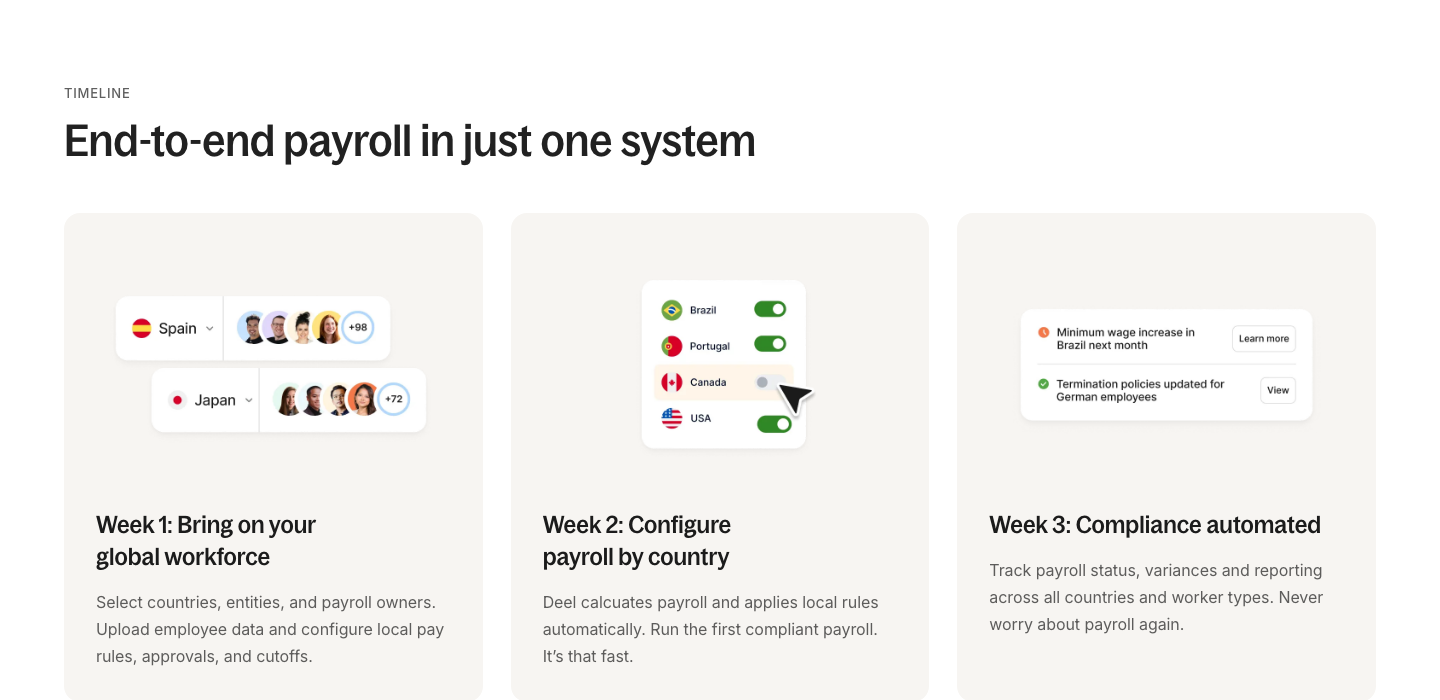
Deel describes the rollout as three weeks. Week one is setup: countries, entities, employee data, local pay rules, approvals and cutoffs. Week two is calculation and the first compliant run. Week three is tracking status, variances and reporting. Treat that as a vendor's best case, and you'll want to confirm the timeline against your own country list and data quality, since a messy employee file will slow any rollout.
Global Payroll worker data can flow from systems such as Workday, SAP, Oracle, Okta and BambooHR. Deel doesn't name accounting or ERP integrations on the payroll page, so check where payroll journals land before you commit.
What does Deel US payroll add?
Deel US payroll offers biweekly, semimonthly or monthly schedules and off-cycle runs, and Deel says it doesn't charge for off-cycle payments. It says it calculates and files payroll taxes with the IRS and with state and local agencies, and files W-2s. The product is aimed at companies with fewer than 200 US employees, with Managed or Self-Serve options. Listed integrations include Workday, BambooHR, HiBob, UKG, SAP SuccessFactors, Employee Navigator, Human Interest and NetSuite for accounting.
Deel doesn't publish a price on its US payroll page. Every call to action there's a demo request, so you'll need a quote to compare it with a domestic payroll provider.
What else does the Deel platform include?
Deel HR is the people records layer. Its Core tier covers profiles, org charts, time off, job structure, workflows, approvals and people analytics, and its Advanced tier adds performance, goals, learning and surveys. It's most useful when you've already got payroll or EOR in Deel and want the same records to drive HR workflows, although a dedicated HR suite may go deeper. If HR is your only need, compare it with dedicated HR suites first.
Deel IT lets you procure laptops and accessories, shipped pre-configured and enrolled in device management. Deel Immigration covers visa support, with an eligibility check, dedicated support, an in-app tracker and renewals. Deel's own pages give different country counts for several of these services, so you'll need to verify your destination country before assuming support.
A US PEO is part of the lineup too. If a PEO is what you need, our guide to PEO software covers the category.
Which integrations does Deel support?
Deel lists its integrations in a marketplace rather than on a single page. Accounting connections include QuickBooks, Xero, NetSuite, Sage, a DATEV sync and Spendesk. HR connections include BambooHR, HiBob, Personio, Workday and SAP SuccessFactors. Applicant tracking connections include Greenhouse and Ashby, and Slack is listed for notifications and workflows.
A logo in a marketplace doesn't prove that the fields you need sync in the direction you need. Ask for a live demonstration of the exact integration, including how it handles a termination date, a cost center change and a failed sync.
How secure is Deel, and what does support look like?
Deel's security page names SOC 1, SOC 2 and SOC 3 reports, ISO 27001 and GDPR, and says data is encrypted at rest with AES-256. Its Global Payroll page adds SOC 2 Type II and regular penetration testing. For access control, Deel mentions Okta single sign-on and role-based access controls. Review the scope of each report, because a certification covers specific systems and not every operational process. Don't assume it covers yours.
On support, Deel says live chat agents are available 24/7, and Deel's support blog also lists email, WhatsApp and phone. Mandarin-speaking agents are available on weekdays, 8 am to 6 pm GMT+8. Managed payroll customers can get a dedicated Payroll Manager. Ask during reference calls how a late or wrong payment was resolved, because that's where support quality shows.
How much does Deel cost?
Deel's pricing page lists starting rates per month: $14 per worker for Find Talent, $49 per contractor for Contractor Management, $325 for Contractor of Record, $125 per employee for US PEO and $599 per employee for employer of record. Deel says it offers month-to-month pricing with no long-term commitment, and it advertises a free demo rather than a free plan.
The EOR fee isn't the full cost. Deel's help center describes a deposit of 1 to 1.5 months of total monthly charges, an Early Invoicing alternative, a mandatory Employer Liability Cost line and a separate severance accrual in countries where statutory termination pay applies. Salary and employer contributions are on top of the fee.
Our Deel pricing guide breaks down each plan and the invoice layers. For a side-by-side with another global hiring vendor, see our Remote pricing article.
What do customers say about Deel?
Customers rate Deel highly on review sites, though the complaints are worth reading. G2 shows 4.7 out of 5 across 7,496 reviews on the listing titled Deel Payroll, with 6,503 five-star reviews against 48 one-star reviews. Deel's own pages also cite 4.7 on G2 and 4.8 on Trustpilot, which are vendor-reported figures we couldn't confirm independently.
Reviewers praise ease of use and convenient payouts, such as simple withdrawals to a local bank and automatic, on-time payments with visible fees. The main complaints are payment issues and high fees. G2 flags some reviews as incentivized, so read recent reviews from your own country and worker type instead of relying on the average.
What are Deel's limitations and risks?
Fees add up. Deel's main limitations are cost, inconsistent country claims, payment timing and open litigation, and high fees are the second most common complaint on G2, and the EOR deposit, employer liability cost and severance accrual make the first-year cash requirement larger than the monthly fee suggests.
Country claims vary on Deel's own pages. EOR coverage appears as both 130+ and 150+ countries, and immigration pages show different country counts. Ask for a written statement for each country and role, since the counts aren't consistent.
Payment timing needs attention. Payment issues are the most mentioned complaint on G2, with 1,015 mentions. Confirm funding deadlines and cut-off times for each country and currency before your first pay run.
Vendor litigation is ongoing. Rippling sued Deel in federal court in San Francisco in March 2025, alleging that Deel paid a Rippling employee to gather confidential information, and Deel denies the allegations. Bloomberg reported in July 2026 that the case was still ongoing, and these are allegations rather than findings. Our Rippling vs Deel comparison covers how the two platforms differ, and you should include vendor risk in your procurement review without treating the allegations as proven.
Vendor concentration cuts both ways. One platform for several worker types simplifies administration, but switching later means moving contracts, payroll history and worker records together. Ask what an exit looks like before you sign, because you'll want that answer in writing.
How does Deel compare with Rippling and Remote?
Rippling, Remote and Deel overlap on global hiring but start from different places. Rippling began as an HR, IT and payroll suite and added global services, which makes it attractive when HR events must also drive device and app access. Remote positions itself around EOR, payroll and contractor plans, while Deel's range of worker types and payout options is what sets it apart.
Use a common scorecard: legal model per country, supported countries, worker experience, payroll accuracy controls, reporting, integrations, support, security, implementation and total cost. Our Rippling vs Deel comparison covers pricing and features side by side. Treat legal requirements as pass or fail rather than letting a lower price offset a missing country.
How should you test Deel before you buy?
Test Deel before you buy by running the demo with your real cases, not the vendor's script. You'll learn more from one messy case than from a polished tour. Bring one new hire in a country where you have no entity, one contractor with an invoice dispute and one payroll correction after a cut-off. Watch which steps Deel's software handles, which its team handles and which land back on your own staff.
- List every country and worker type, then get written confirmation of EOR, contractor and payroll availability for each.
- Ask which Deel entity is the legal employer and who issues the employment contract.
- Request a country quote that splits salary, employer costs, platform fee, deposit, employer liability cost and severance accrual.
- Decide whether Early Invoicing or a standard deposit suits your cash plan.
- Test a contractor payment in the currency and payout method your workers actually use.
- Confirm who owns worker classification for each contractor and what Contractor of Record covers.
- Ask for the exact integration demo for your HRIS and accounting system, including failed syncs.
- Review the SOC reports, data processing terms and single sign-on setup with your security team.
- Define the payroll correction path, cut-off times and escalation contacts per country.
- Agree the exit plan for records, payroll history and contracts before signing.
Where a separate onboarding coordination layer may help
A separate onboarding coordination layer helps when Deel handles the legal employment and payroll side of a global hire but nobody tracks day-one readiness. It doesn't decide who in your company confirms the laptop request, the access approval and the day-one readiness for each starter. The People Ops Manager, the publisher of this blog, focuses on that gap. It shows who's ready for day one, what's blocked and who owns it. It isn't an HRIS, payroll processor or employer of record.
You shouldn't add a coordination tool if Deel's workflows already cover your handoffs. First list the tasks that currently get chased by email, then decide whether they're a tooling gap or an ownership gap.
Final recommendation: is Deel worth it?
Deel's worth a serious evaluation if your company hires in several countries, mixes employees with contractors and wants one vendor behind the employment and payment mechanics. Its reach in contractor payouts, EOR and payroll is a real advantage over stitching together local providers.
Be careful with the total cost, the country-by-country claims and the open litigation. Ask for the full quote, written confirmation for each country and a live demonstration of a hire, a contractor payment and a correction. If it passes those tests, Deel can clearly reduce the number of vendors your People Ops team manages. If it doesn't, a narrower provider may serve you better.
What is Deel used for?
Deel is used to hire, employ and pay workers across countries. Its main services are employer of record, contractor management, Contractor of Record, global payroll, US payroll and HR software.
How much does Deel cost?
Deel's pricing page lists starting rates including $49 per contractor per month for Contractor Management, $325 for Contractor of Record, $125 per employee for US PEO and $599 per employee for employer of record. Salary, employer costs, deposits and other charges are separate, so request a country quote.
Does Deel have a free plan?
Deel doesn't list a free plan on its pricing page. It offers a free demo, and its pricing is described as month to month with no long-term commitment.
How do contractors get paid with Deel?
Fixed rate contracts invoice automatically, while pay-as-you-go and milestone work is invoiced after the contractor submits it and you approve it. Deel then pays approved earnings and expenses in a single bulk payment, using one of its 15+ payout options such as a bank transfer, Wise or Revolut, in 120+ currencies. Timing depends on your funding date and the payout method, so confirm cut-off times for your workers' countries.
Does Deel work in Australia?
Yes for employer of record. Deel has a dedicated page for hiring employees in Australia and says its EOR removes the need for a local entity, with monthly payroll in AUD and a management fee starting at $599 per month. Check the current superannuation rate and employer costs with Deel before you budget.
How does Deel compare with Rippling?
Rippling is stronger when HR events must also drive IT and device workflows, while Deel is built around global hiring, contractors and payments. Compare them on your countries and worker types.