Rippling vs Deel comes down to the operating problem you need to solve. Rippling is a strong candidate when you want employee records, HR workflows, payroll, IT administration, and related operations connected in a broader system. Deel is a strong candidate when international hiring, contractor administration, employer-of-record arrangements, and cross-border workforce operations are central to your requirements. Neither should win on a feature checklist alone, period. The right choice depends on who you employ, where they work, and which processes you need to own. A written quote matters more than a feature list, but only when it itemizes every module and service.
This comparison focuses on the questions a US buyer should answer before requesting proposals. It distinguishes publicly listed starting prices from actual quotes, explains why seemingly similar products may not be equivalent, and provides a practical evaluation framework. It is based on vendor pages, not a hands-on test of either product.
Rippling vs Deel: which one fits your team?
Shortlist Rippling when connected HR and payroll operations are the problem, and Deel when cross-border hiring is. The table and scenarios below show where each starting point leads, and the sections after them explain what to verify.
 Shortlist Rippling for connected employee operations
- Starts at $8 per employee per month plus a monthly base fee, quote required
- Fits teams that want HR, payroll and adjacent workflows on one employee record
- Pricing page also lists Employer of Record, Global Payroll, Global Contractors and Contractor of Record, without prices
- Needs a line-item quote so every required module is included
 Shortlist Deel for cross-border hiring
- Publishes starting prices: $49 per contractor, $325 Contractor of Record, $599 EOR employee, $125 US PEO employee, all per month
- Fits teams hiring in countries where they have no legal entity
- Contractor, Contractor of Record and EOR are separate legal models, not tiers
- Needs a country-by-country scope before the price means anything
| Tool | Core evaluation lens | Public pricing | Best first question | Main diligence area | Common buying mistake |
|---|---|---|---|---|---|
| Rippling | Connected employee operations across HR, payroll and adjacent workflows | From $8 per employee monthly plus base fee; quote required | Can one system cut duplicate employee data and manual handoffs? | Which modules, base fees and implementation services are in the quote | Treating a starting price as an all-in platform price |
| Deel | International workforce hiring, employment arrangements and payments | From $49 (contractor), $325 (CoR), $599 (EOR), $125 (US PEO), each per person monthly Edge | Can one provider support our countries and worker types? | Which legal employment model, country rules and service parts apply | Comparing a contractor fee with an EOR fee |
Each row is an evaluation lens, not a claim that one vendor can't perform the other's functions. Both vendors sell multiple services. Neither's pricing page is a quote, and you shouldn't read it as one. Ask each for a line-item proposal against the same workforce scenario. Who's paying for what, and under which contract, is the question that won't go away.
- Mostly US employees, and you want HR, payroll and IT-adjacent workflows tied to one employee recordRippling
- You need to employ people in countries where you have no entity, through an employer of recordDeel
- You want published starting prices for contractor, CoR and EOR services before talking to salesDeel
- A new hire's data must drive payroll enrollment and account provisioning from one recordRippling
What's the main difference between Rippling and Deel?
The difference is the starting point of your procurement process. A company trying to simplify employee lifecycle administration may first examine how an employee record flows into payroll, access permissions, approvals, and reporting. A company hiring people in countries where it has no legal entity may start with the employment relationship itself: who legally employs the person, who runs local payroll, and who handles statutory obligations.
Those starting points lead to different demonstrations. For Rippling, request a walkthrough of a new hire moving from approved offer to employee profile, payroll enrollment, and account provisioning. For Deel, request a walkthrough of the same worker under the relevant country's contractor, direct employment, or employer-of-record arrangement. Compare the exceptions, not only the ideal path. The ideal path isn't where vendors differ most.
A US company with mostly domestic employees and a few overseas contractors may value different workflows than a distributed company hiring full-time employees in several jurisdictions. A buyer planning to establish its own foreign entities should also evaluate how the proposed operating model changes over time.
How does Rippling pricing compare with Deel pricing?
Rippling's official pricing page says: “Rippling plans start at $8 per employee per month, with a monthly base fee.” It also states that total cost depends on the products and services selected and directs buyers to request a custom quote. This is a starting point, not a verified all-inclusive price for HR, payroll, IT, and international employment.
Deel's official pricing page lists starting amounts for different services. It lists contractor management starting at $49 per contractor per month, Contractor of Record starting at $325 per contractor of record per month, employer-of-record employment starting at $599 per EOR employee per month, and US PEO starting at $125 per US PEO employee per month. These are distinct services and shouldn't be added together or presented as interchangeable tiers. A contractor administration fee isn't a legal employment fee. Here's the simple rule: if a number doesn't name a legal relationship, it isn't comparable.
| Publicly displayed price | What it describes | What it doesn't establish |
|---|---|---|
| Rippling: starts at $8 per employee per month, plus a monthly base fee | Entry point for a modular proposal | Total cost of a configured platform |
| Deel: starts at $49 per contractor per month | Contractor service starting point | Cost of EOR employment |
| Deel: starts at $325 per contractor of record per month | Contractor of Record starting point | Cost of ordinary contractor administration |
| Deel: starts at $599 per EOR employee per month | Employer of Record starting point | Gross salary, statutory employer costs, or every country-specific cost |
| Deel: starts at $125 per US PEO employee per month | US PEO starting point | Cost of a globally employed workforce |
Source: vendor pricing pages, as of November 6, 2026. Published starting prices can change. Confirm currency, eligibility, contract term, included services and effective dates in a written quote. Deel's page, for instance, advertises promotional terms on qualifying PEO order forms, so confirm whether any discount recurs at renewal.
How should you compare the actual quotes?
Use a normalized scenario. Give both vendors the same employee and contractor counts, the same countries, the same anticipated hiring timeline, and the same must-have services. Ask them to identify charges that are fixed, per person, per entity, per transaction, or one-time. Require a separate line for implementation and migration if applicable.
Also ask whether the quote includes local employment costs, benefits, foreign exchange costs, payment charges, support, and offboarding assistance. Some of these are costs of employing a worker rather than software fees. The difference matters because an apparently lower platform price can hide a different service scope.
A useful total-cost worksheet has columns for year-one recurring fees, setup, payroll or payment charges, country-specific charges, benefits administration, optional modules, and renewal assumptions. Keep salary and employer statutory costs separate from the vendor's service charge. They're different budget lines, and finance won't thank you for blending them. Request a sample invoice with sensitive details removed.
Which platform is better for US HR and payroll operations?
Start by mapping your current HR and payroll process rather than comparing marketing category labels. Document how new hires are entered, how changes reach payroll, who approves compensation updates, how benefits changes are reconciled, and what happens when someone leaves. The key question is how many systems and people touch the same record. Here's the catch: a vendor's demo isn't proof that your edge cases work, so test them yourself.
For Rippling, demonstrate the complete workflow using a realistic employee with a location change, a manager change, and a termination. Ask what's automated, what requires configuration, and what requires a separate product purchase. Don't let anyone say "it's on the roadmap" without a date in writing. Treat a feature shown in a demo as outside the base quote until the quote lists it.
For Deel, demonstrate the same process for your US workforce and identify which employment or payroll service is proposed. Ask whether the vendor is processing payroll for your existing entity, participating in a co-employment arrangement, or employing the worker through an EOR. Those are materially different operating models.
The winner is the system that handles your actual exceptions with clear ownership and auditable records. That's the standard to hold both vendors to. A clean dashboard is useful, but correct pay, access, and employee status matter more.
Which platform is better for international hiring?
For international hiring, the first decision is often not software. It's the legal relationship with the worker. A contractor agreement, employment through your own local entity, and employment through an employer of record involve different responsibilities. Ask qualified counsel to assess classification and local employment obligations.
Deel explicitly describes EOR as a way to hire employees globally without opening a local entity. Its pricing FAQ says the EOR fee covers onboarding and local compliance, payroll processing with tax filings, benefits administration, and ongoing HR and legal support. That makes EOR a relevant product to evaluate when you need legal employment in a country without an existing entity. However, country availability, permissible roles, benefits options, and onboarding timelines should be confirmed for each proposed hire.
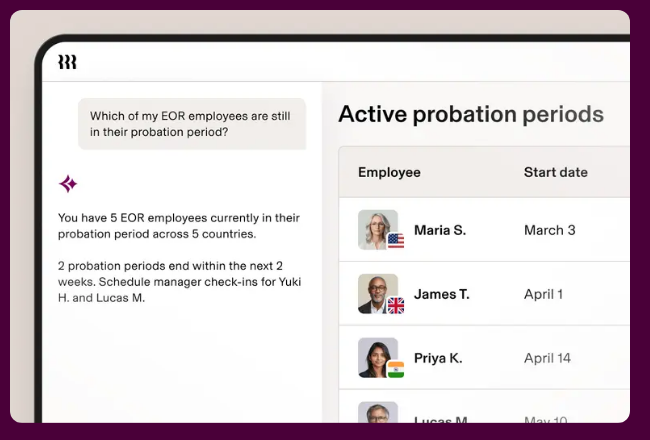
Rippling also markets international workforce services: its pricing page lists Employer of Record, Global Payroll, Global Contractors and Contractor of Record, without prices. Don't assume that a domestic HR quote includes the international employment model you need.
Request a country-by-country scope document identifying the legal employer, payroll processor, service partners if relevant, and escalation route.
For each country, collect the proposed contract type, mandatory benefits, payroll calendar, currency, local holiday rules, termination support, and data handling commitments. Then compare providers on the same scenario. Don't treat a country list as a promise until it appears in your contract. A provider may be suitable for one jurisdiction but require a different arrangement elsewhere. What's offered in one country isn't automatically offered in the next.
What about contractor management?
Contractor management isn't the same as employing staff. For a contractor workflow, test how the platform collects agreements, verifies documentation, accepts invoices, approves payments, and records payment status. Ask how it handles rejected payments, currency conversion, and a contractor who changes residence.
Deel publicly separates contractor administration from Contractor of Record, which signals that the service model matters. A business managing its own properly classified contractors may have a different requirement from one seeking a provider to assume defined classification responsibilities. The label alone doesn't guarantee a particular legal outcome.
For Rippling, ask for a contractor demonstration and an exact list of supported countries and payment methods for your use case. Verify whether contractor onboarding shares data with employee workflows and what access restrictions can be applied. Ask what happens to a contractor's records when they're converted to an employee.
No vendor can eliminate the need for your company to understand the actual work relationship. Of course, classification advice, contract terms, and local-law questions belong in a legal review, not a software checkbox.
How do onboarding and offboarding compare?
Evaluate onboarding as a sequence of responsibilities. HR collects identity and employment information. Payroll needs accurate tax and payment details. IT needs a start date and role-based access. The manager needs equipment and training tasks. Finance needs the correct cost center.
Ask each vendor to show who can edit each field, who approves changes, and what audit trail exists. Use a deliberately messy test case: a hire's start date moves, the manager changes, and the worker's country differs from the hiring manager's. Watch whether changes propagate correctly or require manual correction. Here's a cheap test: change the start date after you've entered the hire, and watch what breaks.
Offboarding deserves equal attention. Test whether the platform coordinates final pay requirements, equipment return, access revocation, document retention, and locally required termination steps. Different jurisdictions have different rules. A generic termination checklist isn't sufficient evidence of compliant processing. Don't skip this step, because unfinished offboarding can leave access and pay issues open.
For both platforms, obtain a responsibility matrix showing what the vendor performs, what your internal team must perform, and what remains with a local partner. The matrix should be part of the implementation plan. If a task isn't on it, nobody's accountable for it.
Which integrations and reporting capabilities matter?
Don't buy based on a long integration-logo page. Write down the systems that actually need to exchange data: accounting, identity management, applicant tracking, benefits, expense management, and business intelligence. For each integration, identify the data owner, direction of sync, frequency, error handling, and whether the integration is included in the quote. Ask who's responsible when a sync fails, and whether they're contractually on the hook.
Request a demonstration of an employee status change flowing into the downstream system. Then ask how failed updates are detected and corrected. A manual export can be acceptable for a small team, but it should be a deliberate choice.
Reporting should be tested with real decisions. Finance should be able to reconcile headcount to payroll costs, HR should be able to spot incomplete onboarding, and security should be able to review active access after a departure. Ask which reports are standard, which need custom configuration, and whether the data can be exported in a usable format. Don't assume a report that's shown in a demo ships with your plan.
Also clarify retention and portability. If you change vendors, you need to retrieve employee records, contracts, payroll history, and audit evidence in a usable form, subject to applicable law.
How should you assess implementation and support?
Implementation quality often determines whether a theoretically capable platform delivers value. Ask for a written project plan, named owners, required data fields, migration approach, testing milestones, and a fallback process if the first payroll run fails.
For a domestic payroll migration, insist on parallel checks of earnings, deductions, taxes, and bank details. For an EOR migration, ask how existing employment relationships, accrued entitlements, and local documents are handled. Don't treat a sales estimate as a contractual implementation commitment. Don't accept "we'll handle it" as a plan, and write down who does what.
Support should be evaluated with realistic incidents. Name who answers when a worker isn't paid, whether support is available during local payroll deadlines, who owns a failed bank transfer, and what the escalation path is for a compliance question. Request service levels and responsibilities in writing, even though sales teams often prefer verbal assurances. If it isn't in the contract, it isn't a commitment.
Ask for a pilot or structured proof of concept where feasible. A useful pilot validates a complete workflow with representative exceptions. It doesn't need to reproduce your entire organization.
Rippling vs Deel: which should you choose?
While every buyer is different, choose Rippling for the shortlist when your main objective is coordinating HR, payroll, and adjacent employee operations and you want to test whether connected workflows reduce manual administration. Its modular quote needs close review so that the final proposal includes every required product.
Choose Deel for the shortlist when your most urgent challenge is hiring and administering workers across borders, particularly when employer-of-record or contractor service models are central. Its public service starting prices help frame the conversation, but they don't replace a country-specific proposal.
Shortlist both when you have a substantial US workforce and meaningful international hiring needs. Shortlisting both isn't a failure of focus. In that case, run two separate demos: one for domestic employee operations and another for cross-border hiring. Score each vendor against the same criteria, but allow the weighting to reflect your actual workforce.
A practical weighted scorecard can cover legal employment fit, payroll accuracy, onboarding, IT and identity workflows, integrations, reporting, support, implementation, security review, and three-year cost. Agree on weights before demos so the team doesn't change the rules to favor a polished presentation.
Questions to ask both vendors before signing
Ask for an itemized quote tied to named services and the relevant countries. Although both vendors sell broad suites, they don't sell identical scopes. Ask which legal entity employs each worker, where payroll processing occurs, which services rely on partners, and what happens if the employment model changes. Confirm how implementation fees, payment charges, optional modules, and renewals work.
Request a security package covering access controls, audit logs, data processing terms, incident response, and subprocessors. It's far easier to ask now than after you've signed. Involve your security and privacy teams early, especially where sensitive payroll and identity data cross borders.
Finally, ask for contract language covering data export, transition assistance, termination notice, service-level remedies, and responsibilities for payroll errors.
- Give both vendors the same employee and contractor counts, countries and timeline
- Get every charge labeled fixed, per person, per entity, per transaction or one-time
- Confirm which legal entity employs each worker in each country
- Ask for the Rippling base fee and every module in writing
- Match each Deel price to one service: contractor, CoR, EOR or US PEO
- Run the same messy hire and exit scenario in both demos
- Request a responsibility matrix for vendor, partner and your team
- Review data export, termination and payroll-error terms before signing
Rippling vs Deel FAQ
Is Rippling cheaper than Deel?
No defensible universal answer exists, because their published starting prices describe different scopes. Rippling advertises a modular per-employee starting point plus a base fee, while Deel publishes starting amounts for specific contractor and employment services. Compare written quotes for the same people, countries, and responsibilities.
Can Deel replace an HR system?
That depends on which HR processes you need and which Deel services you purchase. Test employee records, approvals, reporting, payroll coordination, and integrations against your requirements rather than assuming that one product label replaces every current system.
Can Rippling support an international team?
Rippling markets international workforce services, but you should verify each required country, worker type, and legal employment arrangement in the proposed scope. Don't infer country coverage or EOR availability from a generic HR demonstration.
Do I need an employer of record for overseas hires?
Not always. The answer depends on whether you have a suitable local employing entity, the proposed relationship, and applicable local law. Obtain qualified legal advice before choosing an employment model.
What should I request first?
Send both vendors a workforce matrix and a requirements list. Ask for a country-specific service map, itemized quote, implementation plan, and demonstration of your most difficult workflow. That will produce a more useful comparison than a generic feature checklist.
Bottom line
Rippling and Deel should be compared as potential operating partners, not just software subscriptions. Rippling deserves attention for connected employee operations. Deel deserves attention for international workforce services and clearly differentiated hiring models. Validate each quote against your real workforce, require demonstrations of exceptions, and make legal responsibilities explicit before committing. That's the whole point: it's your workforce, not a feature grid, that decides.