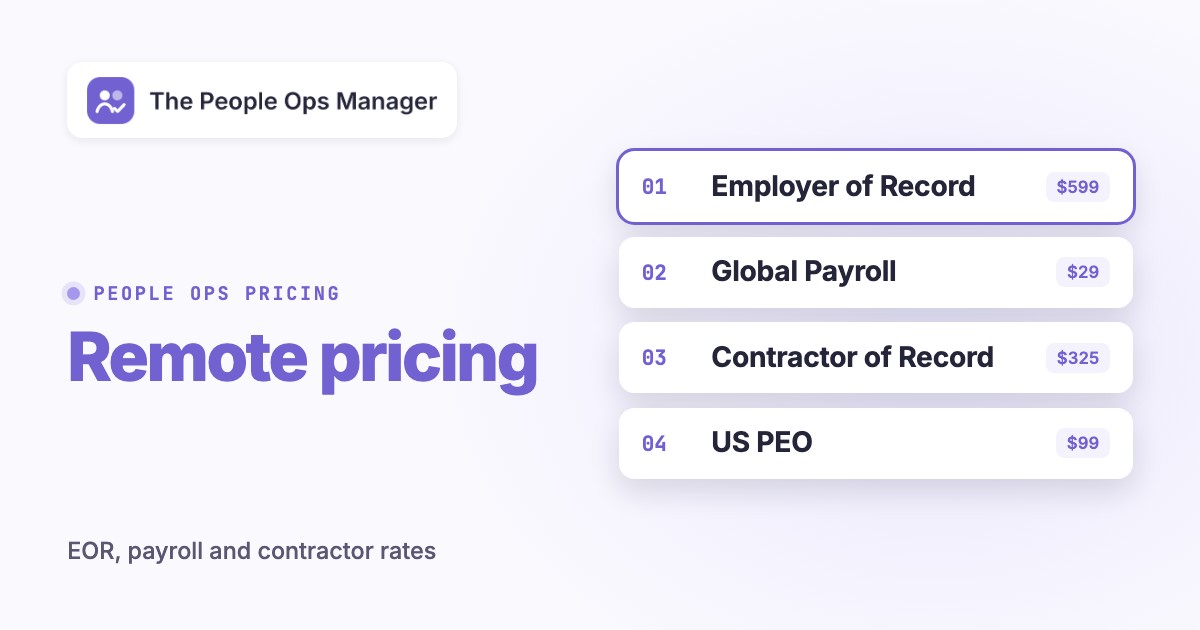
Remote pricing starts at $599 per employee per month for Employer of Record (EOR) on an annual contract, and $699 on the standard monthly rate. Remote, a global hiring and payroll platform, also lists Global Payroll from $29 per employee per month, Contractor Management from $29 per active contractor, Contractor of Record from $325 and a US PEO from $99 per employee. Those are starting service fees, not an all-in international employment budget.
The prices answer different questions. An EOR quote covers the legal employer in a country where you have no entity, payroll covers employees of an entity you already own, and contractor plans cover people who aren't employees at all. For People Ops, the first job is choosing the right employment model, and only then comparing the monthly fee.
- EOR starts at $599 per employee per month on annual contracts; the standard monthly rate is $699.
- Global Payroll and Contractor Management both start at $29, but they serve different legal setups.
- Contractor of Record starts at $325 and US PEO at $99 per employee per month.
- There aren't any standard setup or deposit fees, though a refundable reserve can apply in some cases.
- Partner and nonprofit discounts last about twelve months, then revert to full price.
How much does Remote cost in 2026?
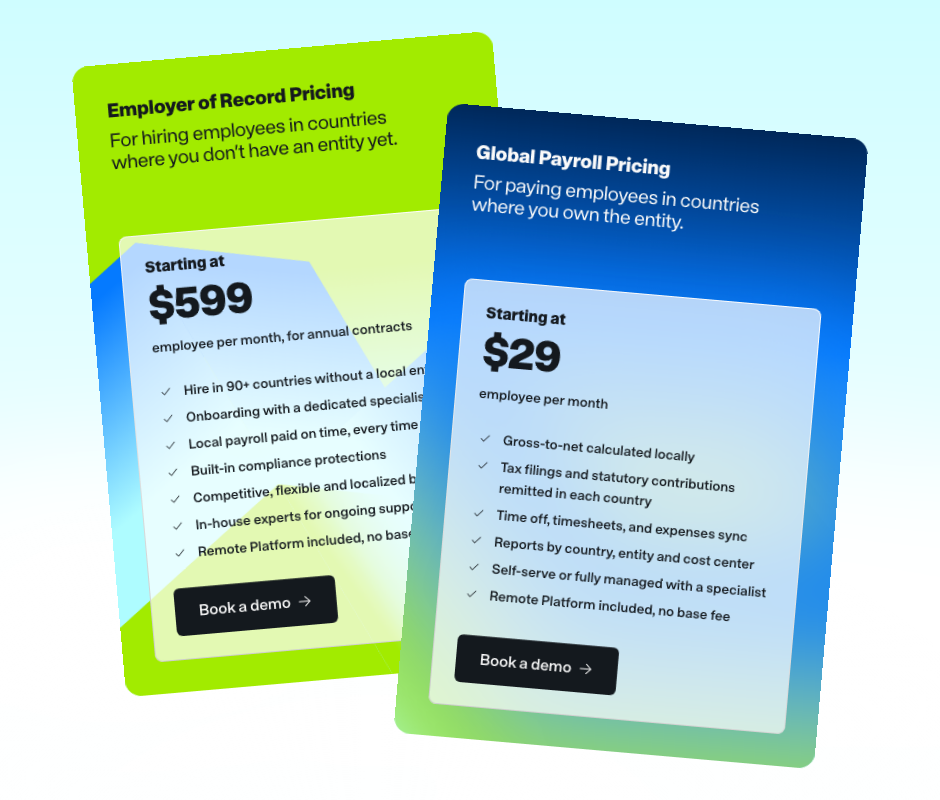
Remote's public US pricing page separates Employer of Record, global payroll, contractor management, Contractor of Record, and US PEO. These solve different hiring problems and aren't interchangeable. For annual contracts, Remote advertises Employer of Record services starting at $599 per employee per month. The word “starting” matters, because it's an entry point rather than a guaranteed rate for every country or employment arrangement.
Remote's Help Center states that its standard EOR price is $699 per employee per month billed monthly based on active usage. It separates pay-as-you-go billing from order-form commitments, but those commitments may carry discounts that aren't public. The two public amounts answer different questions, and they're easy to mix up. A company that needs monthly flexibility shouldn't simply assume the annual-commitment rate applies.
What's the difference between annual and monthly EOR pricing?
An annual EOR contract is a commercial commitment, while the standard month-to-month pay-as-you-go rate applies to active usage under the applicable terms. The public $599 monthly-equivalent starting price has an annual-contract qualifier. At a hypothetical constant headcount of one employee, multiplying $599 by twelve yields $7,188 in annual management fees; $699 times twelve is $8,388. These figures are illustrative arithmetic on public reference rates, not a vendor quote or a full employment cost calculation.
The difference should be compared with the actual order form: cancellation provisions, minimum term, geographic coverage, headcount changes, renewal rules, currency, discounts, and tax obligations all affect the purchase. Some employers value flexibility more than a lower starting price, and that's a fair trade-off. Ask for the exact recurring invoice, since it's what finance will actually pay, and the consequences of an early termination or transfer before estimating savings.
Remote pricing table by product
The official price list shows these US-dollar starting figures. Employer of Record: $599 per employee per month with annual contracts. Global Payroll: $29 per employee per month. Contractor Management: $29 per active contractor per month. Contractor Management Plus: $99 per contractor per month. Contractor of Record: $325 per contractor per month. Professional Employer Organization for US businesses: $99 per employee per month. Each figure needs its product scope and billing condition retained.
| Remote pricing product | Starting price | Billed per | Condition |
|---|---|---|---|
| Employer of Record | $599 | Employee/month | Annual-contract starting rate |
| Standard EOR pay-as-you-go | $699 | Employee/month | Standard monthly rate in the Help Center |
| Global Payroll | $29 | Employee/month | You already own the entity |
| Contractor Management | $29 | Active contractor/month | Pay only for contractors active that month |
| Contractor Management Plus | $99 | Contractor/month | Limited indemnification conditions |
| Contractor of Record | $325 | Contractor/month | Remote contracts with the contractor |
| US PEO | $99 | Employee/month | US eligibility and bank account required |
Don't add the line items blindly. EOR already provides a different legal-employer service than standalone payroll. A quoted package may include features listed as part of the Remote Platform. Confirm your contract instead of stacking every visible product price onto one worker.
- Contractor ManagementFrom $29 per active contractor/month
- Pay only for contractors active that month
- Contracts, templates and payment administration
- You keep the classification responsibility
- Global PayrollFrom $29 per employee/month
- For countries where you own the entity
- Gross-to-net calculated locally
- Statutory contributions remitted
- US PEOFrom $99 per employee/month
- US co-employment
- Billed in USD, US bank account required
- Payroll, HR and compliance support
- Contractor of RecordFrom $325 per contractor/month
- Remote contracts with and pays the contractor
- You direct the work
- Check country and scope
- Employer of RecordFrom $599 per employee/month, annual contract
- Hire without a local entity
- Standard monthly rate is $699
- Salary and employer costs are separate
Published USD starting prices, checked November 5, 2026. Contractor Management Plus is listed from $99 per contractor/month. Salary, employer taxes and reserves aren't included.
- Hire an employee where you have no local entityRemote EOR, from $599 per employee/month on annual contracts or $699 monthly
- Run payroll for an entity you already ownRemote Global Payroll, from $29 per employee/month
- Pay an independent contractor you manage yourselfContractor Management, from $29 per active contractor/month
- Have Remote hold the contract with the contractorContractor of Record, from $325 per contractor/month
- Employ people in the US through co-employmentUS PEO, from $99 per employee/month
What's included in Employer of Record?
Employer of Record is for a company hiring employees in a country where the company doesn't yet have its own legal entity. According to Remote, the service handles local employment administration, payroll, onboarding assistance, localized benefits, and compliance-related support. The customer still directs day-to-day work, but Remote is the legal employer. The exact responsibilities and exclusions are governed by the country-specific service agreement.
Ask which employing entity signs the agreement, which local documents the worker receives, and what happens if employment ends. Don't wait until the offer letter is out to find out. Local severance, statutory benefits, leave, employer contributions, and reimbursements aren't the same thing as the EOR management fee. A $599 or $699 service line doesn't mean the entire fully loaded cost of an overseas employee is that amount.
How does Global Payroll differ from EOR?
Global Payroll is listed from $29 per employee per month and is intended for employers that already own the employing entity. It doesn't replace the legal employer, and it won't remove that entity's obligations. The workflow can include gross-to-net calculation and remittance of required local contributions, subject to the service contract and supported jurisdictions.
For a multi-country operation, collect each entity, number of employees, pay cycles, allowances, integration needs, and reporting requirements. Calculate the payroll platform cost separately from salaries and statutory amounts. Don't describe this starting price as an EOR alternative without explaining that the buyer's legal structure must already be in place.
What does Contractor Management cost?
Remote lists Contractor Management starting at $29 per active contractor per month. The page specifies that you pay for contractors actively worked with during that month, and describes contract preparation, localized templates, payment administration, and related functionality. That isn't an employer-of-record service, and it doesn't automatically make every contractor relationship legally independent.
It's worth noting that Remote also lists Contractor Management Plus from $99 per contractor per month. The Plus plan has a misclassification indemnity described with a $100,000 per-contractor limit and a $1 million company aggregate cap over the term. The vendor footnote narrows this to third-party claims arising from a specified service-warranty breach. It isn't unlimited insurance, nor is it a guarantee that every classification dispute will be covered. Read the actual service terms and exclusions.
When is Contractor of Record the relevant plan?
Contractor of Record is displayed from $325 per contractor per month. Under this model Remote, rather than the customer, is the contractual counterparty for the contractor engagement. The vendor positions it differently from Contractor Management, in which the customer holds the relationship and Remote manages administration.
Ask how intellectual property transfer is documented, who approves statements of work and invoices, what local restrictions apply, and which charges apply for complex engagements. A business shouldn't treat the starting amount as a legal verdict on worker status, because that's decided by facts and law. Classification depends on the facts, applicable law, and working practices.
How much is Remote's US PEO?
Remote's US PEO (Professional Employer Organization) starts at $99 per employee per month according to the public pricing page. Remote describes the service for organizations operating in the United States that need payroll, HR, and compliance support. It says the service requires a US bank account and is billed in USD.
PEO is based on co-employment, not the same legal arrangement as a foreign EOR. Validate whether the business already has the US employing entity, which states are supported, benefits access, payroll migration timelines, and any ancillary expenses. A multinational company may use both models for different segments; pricing must be modeled by employee and service category.
Are there setup fees, deposits, or currency charges?
Remote's public FAQ says its main products have no standard setup or onboarding fees and that the Remote Platform is included without a separate base fee. The FAQ also states there is no standard deposit or deposit fee. In some situations, however, Remote may require a refundable reserve for potential employment obligations. A refundable reserve affects cash flow even if it isn't a service fee, so ask early whether one applies.
Currency conversion needs a separate check, and it's easy to overlook. Remote describes its own foreign-exchange rate for a monthly billing cycle when the invoice currency differs from local payroll amounts. That rate appears on the invoice; it shouldn't be replaced in a forecast with a random spot exchange rate. Confirm the quote currency, payout currencies, local employment costs, and all applicable taxes. Don't assume they're in the headline number.
Are Remote first-year discounts regular prices?
No, Remote has promotional programs whose eligibility and duration are different from public list pricing. For example, Remote runs a landing page for customers referred by Gusto that advertises a referral discount. The amount shown on that page, and its duration, can change, and the page doesn't turn it into a standard rate. Treat any partner offer as a conditional discount, not a universal regular $599 or $699 rate.
Remote for Good also describes conditional discounts for qualifying registered nonprofits and other eligible mission-driven organizations. Its terms specify a twelve-month discount period and annual-plan eligibility for discounted EOR fees. It says the account reverts to the full price after the promotional period. Regional variants of promotion pages show different percentages, so don't publish a single percentage as globally available. Get a dated, written offer with its eligibility, geographic restrictions, and renewal amount. A verbal promise isn't enough, and it won't survive a renewal dispute.
Monthly platform fee at published starting rates. Salaries, employer taxes, reserves and negotiated discounts aren't included.
What should a startup compare in year two?
You'll want at least two scenarios: the first contract year and a steady-state year without promotions. Include the standard service fee appropriate to each billing arrangement, gross compensation, employer taxes, employee benefits, and optional services. If a discount ends after twelve months, the post-discount fee becomes the appropriate renewal baseline unless the signed order form says otherwise.
Use a scenario for one employee and a second for your expected headcount, since the first rarely scales in a straight line. Note the month each employee starts because twelve full months may exaggerate the first-year fee for a midyear hire. Separate one-off deposits or reserves from expenses. Never call a promotional effective rate the enduring subscription price. It's a discount, not the price you'll renew at.
Can I compare Remote with Deel or another EOR?
Yes, you can compare Remote with Deel or another EOR, but normalize both offers to the same country, start date, employment type, headcount, contract term, and benefit assumptions. A headline per-employee amount doesn't include the entire cost of international employment. A provider with a lower management fee may have different services, minimums, reserves, or local employment terms.
Use a comparison matrix recording the service entity, EOR ownership, supported currencies, payroll frequency, time-off handling, data export, incident support, and termination responsibilities. Ask each provider to price the same realistic case, and don't accept averages. Third-party review sites and affiliate comparisons shouldn't be treated as authoritative pricing when a manufacturer page or signed quote is available.
How do annual commitments affect scaling headcount?
A per-employee starting amount isn't a complete commitment model. Ask whether the agreement sets a minimum number of employees, allows replacements, or obliges a customer to pay for workers who leave early. Confirm if changes of employing country alter the fee and whether payments stop automatically at an employment termination date.
Make a cash-flow calendar with onboarding, employment starts, payroll runs, expected departure dates, and renewal milestones. When an EOR worker changes job location or contract type, the service agreement may need adjustment. Model these questions explicitly rather than multiplying an entry price by planned maximum headcount for the whole year.
What hidden costs should be budgeted?
Distinguish unavoidable employment costs from vendor fees, because they're governed by different rules. Employer social contributions, local taxes, statutory severance and benefits are governed by employment law. Platform services are contractual charges. Bank charges, currency conversion spreads, optional benefit upgrades, out-of-cycle payroll or specialized immigration support may require clarification in your own quote.
Ask for an itemized invoice sample and a breakdown between salary funding, benefits funding, taxes, reserves, and management fees. A purchase decision becomes easier when the finance team can trace the cost to a country, worker, accounting entity, and service. Without that separation, “cost per worker” charts can be misleading, and nobody's budget will match the invoices.
How do I request an accurate quote?
To get an accurate Remote quote, prepare a short specification containing the country or countries, headcount by product, role and expected start date, whether the company owns local entities, payroll currencies, benefits expectations, and current HRIS integration. State whether you prefer pay-as-you-go or an annual commitment. Ask the vendor to quote both if available.
Don't accept a bare headline number. Request the list price, any actual agreed discount, the eligibility conditions, the first-year total, the renewal rate, and each one-time cash requirement. Make the seller confirm the treatment of inactive contractors and any geographic exceptions. Save the quote version and expiration date so you've got an audit trail.
Remote pricing FAQs
Is Remote EOR $599 or $699 per month?
The official annual-contract starting rate is $599 per employee per month; Remote's support documentation states $699 per employee per month as the standard monthly EOR rate. Both can be true because the billing commitment differs.
Is Global Payroll included with EOR?
EOR includes payroll services for EOR employees, while Global Payroll is a separately advertised product for companies with their own legal entities.
Are Contractor Management Plus indemnities unlimited?
No. The public footnote states both per-contractor and aggregate caps and refers to defined third-party warranty claims.
Can every customer claim first-year discounts?
No. Partner and nonprofit promotions require eligibility and may expire. A discounted first year should never be labeled the normal subscription.
Is a quote a fixed offer in every country?
No. Confirm country, local labor costs, service scope, currency and applicable conditions in the signed documentation.
Sources and pricing caveats
Prices come from Remote's public US pricing page, its Help Center article on standard EOR pricing and the terms on its Remote for Good page, all read on November 5, 2026. The list isn't a personalized quote, and partner discounts may be withdrawn or changed. Review current regional and contract terms before purchase.