
A 30 60 90 day plan for new hires turns the first three months into a sequence of learning, contribution, and growing ownership. The manager defines role outcomes, the new employee helps refine them, and People Ops coordinates the setup work that makes those outcomes possible.
Below you'll find a free template to download as Word, Excel or PDF, built around milestones, owners, evidence, and an explicit blocker field, so a missing laptop or approval doesn't get mistaken for poor performance. It's a working agreement, not a promise that every employee will reach full productivity on the same date. If you came looking for a plan to present in a job interview, see the short note near the end.
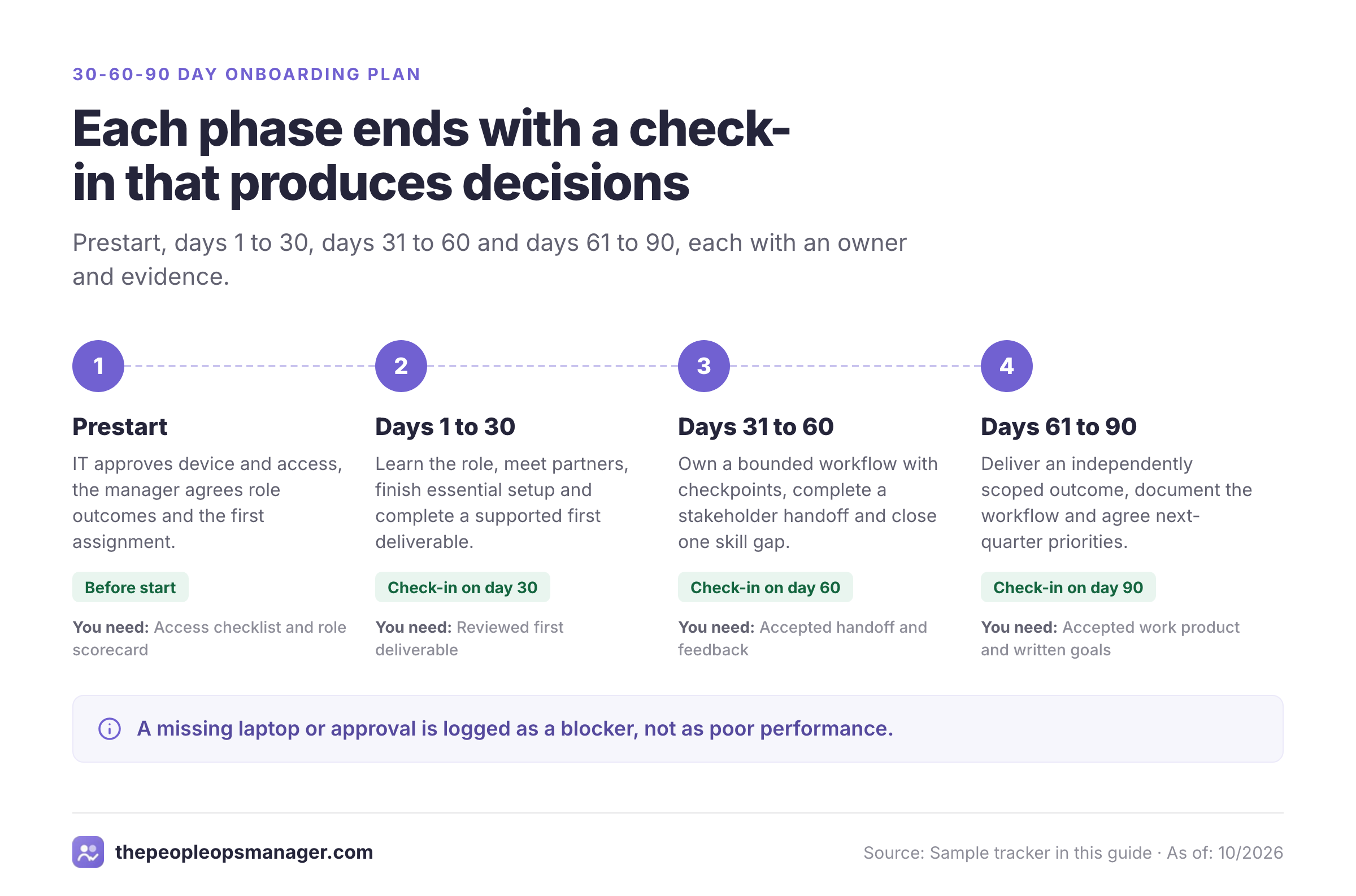
- Days 1 to 30: learn the role, meet partners, complete essential setup, and finish a supported task.
- Days 31 to 60: contribute to a real workflow with feedback and a clear definition of done.
- Days 61 to 90: own an appropriately scoped outcome and agree on next-quarter priorities.
- Give every milestone an owner, due date, evidence field, and escalation route.
- Use the same plan for manager and employee check-ins, not a separate performance surprise.
What is a 30 60 90 day plan for new hires?
A 30 60 90 day plan for new hires is a shared document that states what a new employee should understand, practice, and eventually own during the first three months. It should make expectations observable without turning onboarding into a rigid pass-or-fail exam. The 30, 60, and 90-day points are review horizons. They're not legal deadlines or universal productivity benchmarks.
A useful plan states which outcome matters, what the employee must learn first, who provides access or coaching, what evidence shows progress, and what happens when a dependency slips. If it doesn't say who provides access and what happens when a dependency slips, it's a wish list rather than an operating plan.
Keep two related records distinct. The onboarding checklist covers equipment, payroll inputs, identity verification, policy acknowledgments, and other administrative work. The 30-60-90 plan covers learning and role outcomes. They should share owners and dates, but the employee shouldn't be assessed on a task that another department failed to complete. For logistics, pair this guide with the new hire onboarding template and the onboarding process flowchart.
Onboarding guides often cite the four Cs that Talya Bauer described in a 2010 SHRM Foundation guideline: compliance, clarification, culture and connection. The checklist carries compliance. The 30-60-90 plan carries mostly clarification (what is expected, by when) and connection (who helps), and it's where culture gets a place to show up in the buddy and manager conversations. Some versions add a fifth C, so it's a thinking aid, not a standard.
Free 30 60 90 day plan template for new hires
30 60 90 day plan template for new hires
Copy the tables into your team's approved document or spreadsheet, or download them. Grey values are examples: replace them with role-specific work, set real calendar dates, and agree on what counts as evidence.
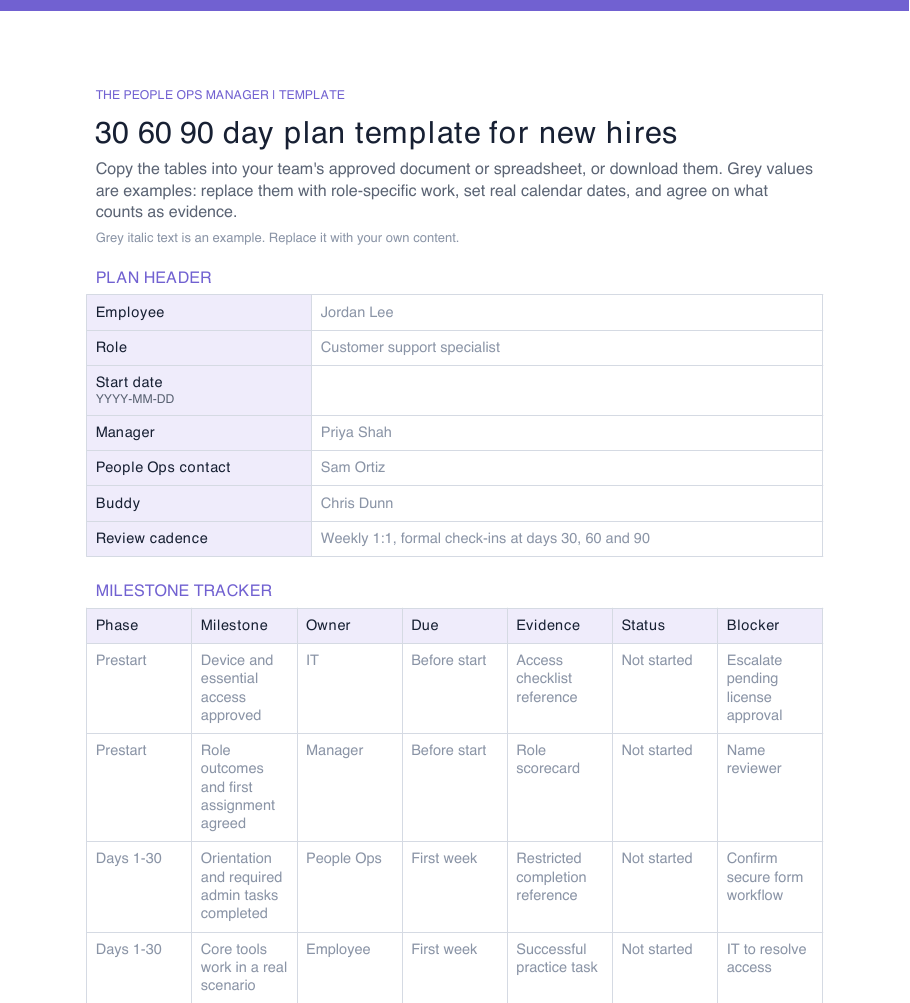
- Employee
- Jordan Lee
- Role
- Customer support specialist
- Start date
- YYYY-MM-DD
- Manager
- Priya Shah
- People Ops contact
- Sam Ortiz
- Buddy
- Chris Dunn
- Review cadence
- Weekly 1:1, formal check-ins at days 30, 60 and 90
| Phase | Milestone | Owner | Due | Evidence | Status | Blocker |
|---|---|---|---|---|---|---|
| Prestart | Device and essential access approved | IT | Before start | Access checklist reference | Not started | Escalate pending license approval |
| Prestart | Role outcomes and first assignment agreed | Manager | Before start | Role scorecard | Not started | Name reviewer |
| Days 1-30 | Orientation and required admin tasks completed | People Ops | First week | Restricted completion reference | Not started | Confirm secure form workflow |
| Days 1-30 | Core tools work in a real scenario | Employee | First week | Successful practice task | Not started | IT to resolve access |
| Days 1-30 | Key partners and escalation paths identified | Employee | By day 20 | Stakeholder map | Not started | Manager to introduce owner |
| Days 1-30 | Supported first deliverable reviewed | Employee | By day 25 | Reviewed artifact | Not started | Reviewer to reserve time |
| Days 1-30 | Learning and blockers reviewed together | Manager | Day 30 | Check-in decisions | Not started | Agree revised scope |
| Days 31-60 | Own a bounded workflow with checkpoints | Employee | By day 45 | Work sample and feedback | Not started | Clarify approval threshold |
| Days 31-60 | Complete a stakeholder handoff | Employee | By day 50 | Accepted handoff | Not started | Confirm receiving owner |
| Days 31-60 | Identify and address a skill gap | Manager | By day 55 | Coaching action and follow-up | Not started | Book peer support |
| Days 31-60 | Review contribution and adjust goals | Manager | Day 60 | Check-in decisions | Not started | Rebaseline if needed |
| Days 61-90 | Deliver an independently scoped outcome | Employee | By day 80 | Accepted work product | Not started | Resolve external dependency |
| Days 61-90 | Document the recurring workflow or decision | Employee | By day 85 | Usable handoff note | Not started | Obtain reviewer feedback |
| Days 61-90 | Agree on next-quarter priorities | Manager | Day 90 | Written goals and owners | Not started | Confirm business priorities |
| Days 61-90 | Review onboarding experience and unresolved issues | People Ops | Day 90 | Improvement actions | Not started | Assign follow-up owner |
- The employee and manager agree on the role's initial scope.
- Each milestone describes a visible outcome or deliverable.
- Every task has one owner and a due date.
- Access, payroll, and HR compliance tasks have separate secure records.
- A reviewer is named for each work product.
- Blocked items have an escalation owner and next action.
- Check-in meetings are on the calendar.
- The employee can request changes without treating the plan as a disciplinary document.
The table is a sample, not a fixed policy, and you'll want to edit every row. A frontline role, a licensed profession, and an executive role have different readiness conditions. Some milestones may happen earlier, and others may reasonably extend beyond day 90. If a task isn't relevant, remove it rather than checking it off for appearance's sake. Each row has one accountable owner, even when several people help, because when everyone's accountable, nobody is. A status of Blocked should name the dependency and the next action, and it shouldn't blame the employee.
How to make each row actionable
Write a milestone as an observable result, not an activity that someone can complete without learning anything. "Attend CRM training" only proves attendance. "Create a correctly routed test record and explain the escalation path" shows whether the employee can use the workflow. Pair that outcome with a reviewer and an evidence location.
Use consistent statuses, because they're what makes the table scannable: Not started, In progress, Blocked, Done, and Replanned. When a deadline changes, retain the original due date in the underlying history if your system supports it. The plan should show why a milestone moved and who accepted the new date. Avoid creating a public scoreboard of individual new hires.
What should happen before day one?
Start with the job's actual work. Ask the hiring manager for a role scorecard, a realistic first assignment, the systems required, and the people who can review the output. Then work backward to setup tasks. The manager shouldn't wait until the employee arrives to discover that access requests need approvals.
- Hiring managerDefine the first supported deliverable, reviewer, and success criteria Before start
- People OpsConfirm start date, orientation, policy contacts, and administrative handoffs Before start
- ITPrepare approved device and role-appropriate access; document unresolved approvals Before start
- Finance / payrollConfirm payroll setup owner and the secure path for required information Before first payroll
- Buddy / peerReserve time for questions and practical workflow walkthroughs First week
- Employee + managerReview and adjust role goals together First week
- ManagerHold milestone conversations and agree on any scope changes Days 30, 60 and 90
Separate legal tasks from coaching milestones. For US hires, the USCIS Form I-9 instructions say employees complete Section 1 no later than their first day of employment. Employers generally complete Section 2 within three business days after the employee's first day. If you hire someone for fewer than three business days, Section 2 is due no later than their first day of employment. Consult the USCIS instructions for the full requirements. Treat these as compliance tasks with their own owners, since they don't wait for the day-30 conversation.
The IRS says employers should ask new employees for a signed Form W-4 when they start work and use it for withholding with the first wage payment. Route the form through the employer's secure payroll process, not a shared onboarding spreadsheet. See the IRS hiring guidance. State and local requirements can add other steps. Assign someone to check them, since this plan doesn't replace legal review.
What belongs in days 1 to 30?
The first phase is about learning how work gets done and producing a low-risk result with support. The manager should explain why the role exists, which outcomes matter, and how decisions move between teams. People Ops should make sure orientation and setup issues have named owners, so nothing's left floating. The employee should feel free to ask basic questions without pretending they've already got the answer.
A practical week-one sequence is: confirm access, meet the manager, walk through the team's actual workflow, identify the people who approve or review work, and schedule a first supported task. Use the rest of the month to practice. Avoid assigning a large independent project before the employee has seen how the team handles exceptions. Let them see one handled first.
For a customer support specialist, the supported result might be a practice response reviewed against the team's quality criteria. For a software engineer, it might be a small change that passes the team's review and deployment process. For an HR coordinator, it might be a correctly routed mock onboarding case, with no real employee documents exposed.
The day-30 checkpoint should produce a decision: continue as planned, provide targeted support, or change a goal. Ask what the employee understands, which system or relationship remains unclear, and which dependency is slowing them down. Capture the manager's action as well as the employee's action. If the laptop arrived late, the plan must not quietly treat lost practice time as a performance gap.
What belongs in days 31 to 60?
The middle phase shifts from guided practice to useful contribution. A deliverable with no named reviewer clearly isn't ready to assign. Assign work with a defined boundary: what the employee may decide independently, what needs review, and who accepts the output. A good milestone isn't an attendance metric or an unbounded promise such as "own the entire process."
The manager should offer feedback while there's still time to apply it. Review one real deliverable together. Identify the decisions that required escalation. If the employee repeats a mistake, distinguish missing knowledge from unclear instructions, broken tooling, or conflicting stakeholder expectations.
This is also when you'll test handoffs. A recruiter may pass an accepted offer to People Ops. People Ops may need IT to provision access. A new sales employee may need a manager to approve a proposal. In each case, completion means the next owner accepted the handoff, not just that someone sent a message.
At the day-60 checkpoint, look for evidence of contribution and a realistic path to ownership. The employee and manager should decide which work can be handled with less supervision, which skills still need practice, and whether the original day-90 goal remains appropriate. Replanning is a sign of active management, and it's clearly not automatically a failure.
What belongs in days 61 to 90?
The final phase tests appropriately scoped ownership. Give the employee a real outcome with a clear customer, stakeholder, or internal recipient. Ask them to plan the work, identify risks, use the normal review path, and document the result so the next person doesn't start from zero. Independence doesn't mean skipping approvals or working without support.
For a payroll specialist, the milestone may be preparing a reconciled draft for review rather than approving payroll alone. For an IT administrator, it may be completing a documented access request with the required sign-offs, not granting unrestricted permissions. For a people manager, it may be running a team planning cycle and proposing improvements after listening to the team.
At the day-90 checkpoint, compare the original outcomes with actual evidence. Discuss the quality of work, judgment about escalation, collaboration, and what support they'll still need. Agree on next-quarter priorities. The review should also ask whether the organization delivered the promised tools, coaching, and access. Don't use the onboarding plan as a substitute for formal performance policies or legally required procedures.
Who owns the plan across HR, IT, finance, and the manager?
The hiring manager owns role expectations and evaluates work. People Ops owns coordination of the onboarding process and the visibility of unresolved administrative tasks. IT owns device and access provisioning under company policy. Payroll or finance owns the secure payroll handoff. The employee participates in goal-setting and provides evidence of work, but shouldn't have to chase every department without an escalation path.
| Workstream | Accountable owner | Evidence the plan should reference | Common failure |
|---|---|---|---|
| Role goals and milestones | Hiring manager | Approved role scorecard | Generic goals copied between jobs |
| Orientation and policy handoffs | People Ops | Completion status in approved HR system | Nobody follows up after orientation |
| Device and access readiness | IT | Provisioning confirmation | Approval stuck with an unnamed owner |
| Payroll setup | Payroll / finance | Restricted payroll setup status | Sensitive forms shared in chat |
| Practice and coaching | Manager with peer reviewer | Feedback on work sample | Training attendance mistaken for competence |
| New hire feedback | People Ops | Private issue and action log | Concerns collected but never resolved |
A common design error is putting "HR" as the owner of every row. HR can coordinate a process without being able to approve a software license, review a code change, or define sales performance. A plan is useful when you can see who's actually making each decision. If your team needs to model these handoffs before assigning tasks, use the onboarding process flowchart.
A coordination layer can help teams see whether the onboarding prerequisites are ready and who needs to approve a blocked step. It should complement the HRIS, payroll system, and identity tools rather than pretend to replace them. Confirm any product's current integration and approval capabilities before adopting it.
30 60 90 day plan examples by role
Keep the same fields and phase structure when you write a plan for each new hire. Change the deliverables, review criteria, and level of independence. Here are sample milestones for different roles. These are illustrative targets to calibrate with your own team. They aren't industry benchmarks.
Example: customer support representative
Learn: Observe the escalation path, practice responses in a sandbox, and complete a reviewed example using the team's quality rubric. Contribute: Handle a bounded queue with quality reviews and record when an issue needs escalation. Own: Manage a defined queue segment, explain recurring issues, and propose a knowledge-base improvement. The reviewer should assess accuracy and judgment, not just ticket volume.
Example: software engineer
Learn: Set up approved development access, understand the release process, and complete a small reviewed change. Contribute: Deliver a scoped change with tests and code review, and explain dependencies. Own: Take a bounded feature or reliability improvement through the team's normal release controls. The manager should account for environment delays and review turnaround, not assume every codebase has the same ramp time.
Example: sales development representative
Learn: Explain the ideal customer profile, practice discovery questions, and demonstrate correct CRM hygiene. Contribute: Run a supervised prospecting workflow and review message quality with the manager. Own: Manage an agreed segment and report what's working. Avoid judging the employee solely on closed revenue when the role doesn't control closing or when the sales cycle extends beyond onboarding.
Example: HR operations coordinator
Learn: Map offer acceptance, payroll handoff, I-9 responsibility, and access approvals. Contribute: Coordinate a simulated or supervised onboarding case with a clear audit trail. Own: Manage a routine onboarding case, escalating exceptions to the right specialist. Never use a shared training document to store real identity or tax records. Real records belong in approved systems.
Example: new people manager
Learn: Meet team members, understand commitments, and review existing metrics before proposing changes. Contribute: Run regular team conversations, resolve a narrow blocker, and document decisions. Own: Lead a planning cycle, clarify responsibilities, and agree on development priorities with the team. A manager's plan should measure listening and decision quality as well as deliverables. Those measures differ from an individual contributor's plan.
How should the 30, 60, and 90-day check-ins work?
Put each conversation on the calendar at the start, so it doesn't get squeezed out later. Share the same plan with the employee beforehand and invite written notes, so they're prepared. A checkpoint should result in a small number of decisions, each with an owner and date. A conversation that ends with "keep going" but no documented action won't help either person.
Review the evidence
Look at the actual work products, feedback, and completed prerequisites. Don't substitute training attendance for demonstrated skill.
Separate employee work from organizational blockers
Check access, reviewer availability, workload, and any instructions that weren't clear. Assign the blocker to whoever can resolve it.
Agree on the next scope
Keep, revise, or replace the upcoming milestones. Explain what changed and how success will be assessed.
Record decisions and follow up
Write the owner, action, due date, and evidence location. Share the agreed summary with the employee.
Day-30 prompts: Ask what the employee can now do that they couldn't at the start, which workflow still feels unclear, what support has been missing, and what you should change before the next review.
Day-60 prompts: Ask for the real output that best shows their contribution, where they needed approval or coaching, what responsibility they're ready to own next, and what the manager should stop or start doing.
Day-90 prompts: Ask which outcomes were accepted, what decisions they can now make independently, where escalation should remain mandatory, and what goals and support should carry into the next quarter.
Document feedback fairly. If the plan changes because of a medical accommodation or another sensitive matter, keep protected details in the appropriate restricted process. The EEOC describes a request for reasonable accommodation as the first step in an informal, interactive process between the individual and the employer. Refer to EEOC guidance, and consult qualified HR or legal staff for specific cases.
What is the 90 day rule for new employees?
There's no general federal 90 day rule for new US employees. The number comes from two common places. Many employers use a 90-day introductory or probationary period, which is a company policy and not a legal status. And group health plans may not apply a waiting period longer than 90 days before coverage starts, a limit set in 45 CFR 147.116. A new hire's plan shouldn't claim more than either source supports.
In practice, treat day 90 as the date your own policy and your benefits plan attach consequences to, and write it into the plan header so the employee sees the same dates you do. Whether employment is at will, what an introductory period changes, and how state law applies are questions for your handbook and counsel, and the template doesn't settle them.
How do you measure whether onboarding is working?
Measure the quality of the handoff and the employee's ability to perform agreed work. Don't confuse a high checklist completion rate with readiness. A better dashboard separates readiness, learning, contribution, and support. That helps a People Ops team see whether the organization or the employee needs to act.
| Signal | How to observe it | Who acts on the result |
|---|---|---|
| Setup readiness | Required access and equipment confirmed before dependent work | IT and People Ops |
| Training transfer | Employee demonstrates the workflow in a real or safe practice case | Manager and reviewer |
| First useful output | A defined deliverable is accepted with feedback | Manager |
| Handoff reliability | Receiving owner confirms the task is usable | Sending and receiving owners |
| Blocker resolution | Open issues have owners and a next action | People Ops and functional lead |
| Employee clarity | Employee can explain priorities and escalation routes | Manager |
| Next-quarter readiness | Goals and support needs are documented together | Manager and employee |
For a quantitative view, define the numerator and denominator before collecting data. Milestone completion rate can mean accepted milestones divided by milestones due, but exclude or separately label milestones that were formally replanned. Access readiness can mean hires whose required systems were confirmed before start divided by hires who needed those systems. These are proposed operational definitions, not published benchmarks, so don't quote them as industry numbers. Track trends across cohorts rather than comparing unrelated roles on a single score.
When a milestone slips, record the cause. "Waiting for customer data" and "needs additional coaching" require different actions. If you aggregate results, protect individual privacy and avoid making employment decisions from a simplistic score. The goal is to improve onboarding and make fair, informed decisions.
What mistakes should you avoid?
Using the same output targets for every role. The structure can be reusable; the success criteria can't. A regulated specialist may need supervised practice long after a generalist starts working independently.
Treating day 90 as an automatic performance verdict. It's a coaching and coordination tool. Formal performance decisions should follow your organization's actual policy and applicable requirements.
Assigning work before prerequisites exist. If IT hasn't approved access, move the dependent milestone and document the blocker. Don't leave the employee responsible for someone else's queue.
Making the employee chase five teams. One People Ops coordinator can track cross-functional status while the functional owners complete their own tasks. Coordination isn't the same as ownership of every decision.
Recording sensitive data in the wrong place. Store only a completion status or restricted reference in the plan. Use approved systems for tax, identity, and accommodation records.
Scheduling check-ins without decisions. Each conversation should produce a specific next action or a clear statement that the scope hasn't changed, with evidence and owner.
Mistaking the template for a compliance system. A planning table doesn't perform Form I-9 verification, process payroll, or satisfy every state-specific onboarding requirement. Keep those procedures in their appropriate systems.
Is this the same as the 30 60 90 day plan in a job interview?
No. A job candidate writes a 30-60-90 plan to show an interviewer how they would approach a role. A new-hire plan is written by the employer after the offer, with the manager and People Ops, and it records owners, evidence and blockers. The three-phase shape is the same, but who writes it and why aren't. Candidates can borrow the phase structure and replace the owner and blocker columns with their own assumptions.
Frequently asked questions
Who should write a 30 60 90 day plan for new hires?
The hiring manager should draft role outcomes before the employee starts. The new hire should help refine them in the first week. People Ops coordinates administrative dependencies, while IT and payroll own their setup tasks, and the employee shouldn't be the one chasing them.
What is the difference between a 30-60-90 plan and an onboarding checklist?
The checklist tracks administrative readiness, and it's separate from the plan's learning goals. The 30-60-90 plan defines what the employee should learn, contribute, and own. Link them so a missing prerequisite is visible, but don't judge the employee for another team's delay.
Should every new hire be fully productive by day 90?
No. The dates are useful review horizons, and they aren't universal productivity standards. Adjust milestones for the role's complexity, training needs, and available support.
What if a new hire misses a milestone?
Check whether the expectation was clear, whether the prerequisites were available, and whether coaching or scope changes are needed. Record the reason, new action, owner, and date. Follow the organization's formal policies where relevant.
Can the same template work for remote onboarding?
Yes. Keep the same goals and ownership fields, since they're what holds the plan together. Add equipment delivery confirmation, remote access checks, time-zone-aware check-ins, and explicit introductions to people who would otherwise be met informally.
Is a 30 60 90 day plan for new hires legally required?
The plan itself is a management practice, and it isn't a substitute for legally required onboarding steps. US employers should separately follow applicable Form I-9, payroll, and state requirements.
What should a 30 60 90 day plan for a new hire include?
Each phase needs outcomes the employee can show, an owner for every task, a due date, the evidence that proves it is done, and a blocker field with a named escalation route. Add the check-in dates and keep compliance paperwork in your HR and payroll systems, linking only a completion status.
What is the 90 day rule for new employees?
There's no general federal rule. Ninety days is a common company probation period, and group health plans can't impose a waiting period longer than 90 days under 45 CFR 147.116.