An onboarding buddy program pairs each new employee with a colleague who helps them navigate everyday work, informal norms, and practical questions during their first weeks. A buddy isn't the new hire's manager, performance evaluator, or substitute for a structured onboarding plan. The role is to make small questions easy to ask and to help a new colleague build relationships without relying on guesswork. A useful program defines who can serve as a buddy, what they should do, when they should meet, and how People Ops will evaluate whether the arrangement is working.
- A buddy is a peer guide for everyday work and relationships, not a manager, evaluator or policy source.
- Write a one-page charter with responsibilities, boundaries and escalation contacts before you recruit anyone.
- Pick buddies with capacity and workflow knowledge, and make rematching easy and private.
- Assign the buddy before day one, then taper from orientation to troubleshooting over the first weeks.
- Measure coverage, first-contact timing and new-hire feedback, and fix the documentation gaps buddies expose.
What is an onboarding buddy program?
An onboarding buddy program is a repeatable process for assigning a peer guide to a new employee. The buddy explains how work actually happens, introduces useful contacts, and helps the employee locate information. For example, a new analyst might know how to use the reporting platform but not know which team owns a data definition. Their buddy can explain the internal request path and introduce the right person. The buddy shouldn't invent policy answers. When questions concern payroll, benefits, immigration, safety, accommodations, or employment rules, the buddy should direct the employee to the appropriate authorized team.
The distinction between a buddy and a mentor matters. A mentor usually supports longer-term professional growth, often through career advice and reflection. A buddy provides short-term orientation and social support. One person can play both roles in a small organization, but the expectations should still be explicit. A manager remains accountable for job expectations, priorities, feedback, and performance, which is what a 30-60-90 day onboarding plan is for. People Ops remains accountable for the onboarding process and official policy guidance.
What is another name for an onboarding buddy?
An onboarding buddy is also called a work buddy, peer buddy, onboarding partner, new hire buddy, or onboarding ambassador, and the arrangement is often called a buddy system. The label changes by company, but the job is the same: one peer who helps a new employee with everyday questions. Outside the workplace, "buddy system" has other meanings. In safety work it means two people who watch out for each other, and in schools it usually pairs an older student with a newcomer. This guide covers only the workplace onboarding version.
What is the difference between a buddy and a mentor?
A buddy gives short-term orientation help during the first weeks, while a mentor supports career growth over months or years. A buddy answers "how do we do this here?" and a mentor answers "where could my career go?". Buddies are usually peers on a similar level, and mentors are usually more senior. The buddy relationship ends with a formal handoff, and a mentoring relationship can continue as long as both people want it. Neither role replaces the manager, who owns priorities and feedback.
Why should People Ops create a buddy program?
The strongest case for a buddy program is operational clarity. New hires face dozens of small uncertainties that aren't always covered by orientation slides: which channel to use, where to find an example, how to request help, and who approves routine decisions. A named peer contact reduces the friction of finding someone to ask. A buddy also makes social introductions more intentional, especially for remote hires who can't overhear office conversations.
Published figures show why onboarding deserves attention. Gallup finds that "only 12% of employees strongly agree that their organization does a great job onboarding new employees." Microsoft's Viva Insights team reports that 56 percent of new hires who met with their onboarding buddy at least once in their first 90 days said the buddy helped them become productive quickly, and that this rose to 73 percent for those who met two to three times. The same post says that after the first week, new hires with buddies were 23 percent more satisfied with their overall onboarding experience than those without buddies. These are self-reported survey results, not controlled experiments.
A buddy program isn't proof that retention or productivity will improve. Those outcomes depend on management, role design, workload, and many other factors. Treat the program as a testable intervention. Don't promise a fixed percentage improvement. Record a baseline, gather new-hire feedback, and review whether the buddy interactions are helpful. If people report friendly conversations but still can't access essential systems, fix the access process instead of expanding the buddy role.
Who should be an onboarding buddy?
An onboarding buddy should be an employee who understands day-to-day workflows, communicates clearly, and has enough capacity to be responsive. Tenure alone isn't a sufficient criterion. Someone who's joined relatively recently may remember confusing steps particularly well. A strong buddy knows when to say, 'I'm not sure; let's find the owner,' rather than improvising an answer. Managers should confirm that buddy responsibilities fit within normal workload, because a buddy who's overloaded won't answer quickly.
Match on work context and practical overlap. A teammate in the same function can answer process questions quickly, while someone from another department can broaden relationships. Either model can work. Consider time zones, language needs, accessibility, work schedules, and potential conflicts of interest. Don't automatically pair a new hire with a direct evaluator. Give people a simple way to ask for a different buddy without making either employee explain private reasons.
What are the buddy's responsibilities?
The buddy's core responsibilities are to welcome the new hire, offer a reliable contact point, explain informal work practices, make introductions, and help locate approved resources. The buddy can show how to find a project brief or submit an IT ticket, and they shouldn't guess when they don't know. They should encourage the new hire to use official documentation rather than becoming the only source of knowledge.
Set boundaries before launch. Buddies shouldn't assess performance, promise promotions, interpret legal requirements, handle confidential employee complaints, or give unofficial answers about compensation. Sensitive questions should go to a manager, People Ops, legal, security, or another designated owner. Buddies should also avoid requesting unnecessary personal information. A good program makes escalation paths visible and tells buddies it's fine to refer a question rather than solve everything themselves.
How do I launch an onboarding buddy program?
Launching an onboarding buddy program starts with a narrow pilot and a documented owner. Identify the employee groups included, select a matching approach, train volunteers, and schedule interactions before the new hire arrives. The program owner should keep a lightweight assignment log and check that each new hire has a buddy with actual availability. A simple shared tracker is often enough.
Follow these six steps for the pilot.
Write a one-page charter
Describe the purpose, duration, responsibilities, boundaries and escalation contacts.
Recruit volunteers
Ask managers to confirm that buddy duties fit inside normal workload.
Match each new hire
Use team context, availability, time zones and reasonable preferences, and keep the criteria consistent.
Introduce the pair
Connect them before or on the first day with a clear invitation to meet.
Share a conversation guide
Give the buddy a short list of useful links, sample questions and the escalation map.
Collect feedback privately
Ask both people what worked, then improve the process after the pilot.
Don't make participation a hidden performance requirement for buddies. If the organization wants broad coverage, recognize the time required and build it into team planning. Keep the matching criteria consistent enough to be fair, while allowing reasonable adjustments for a person's schedule or access needs.
What should happen before day one?
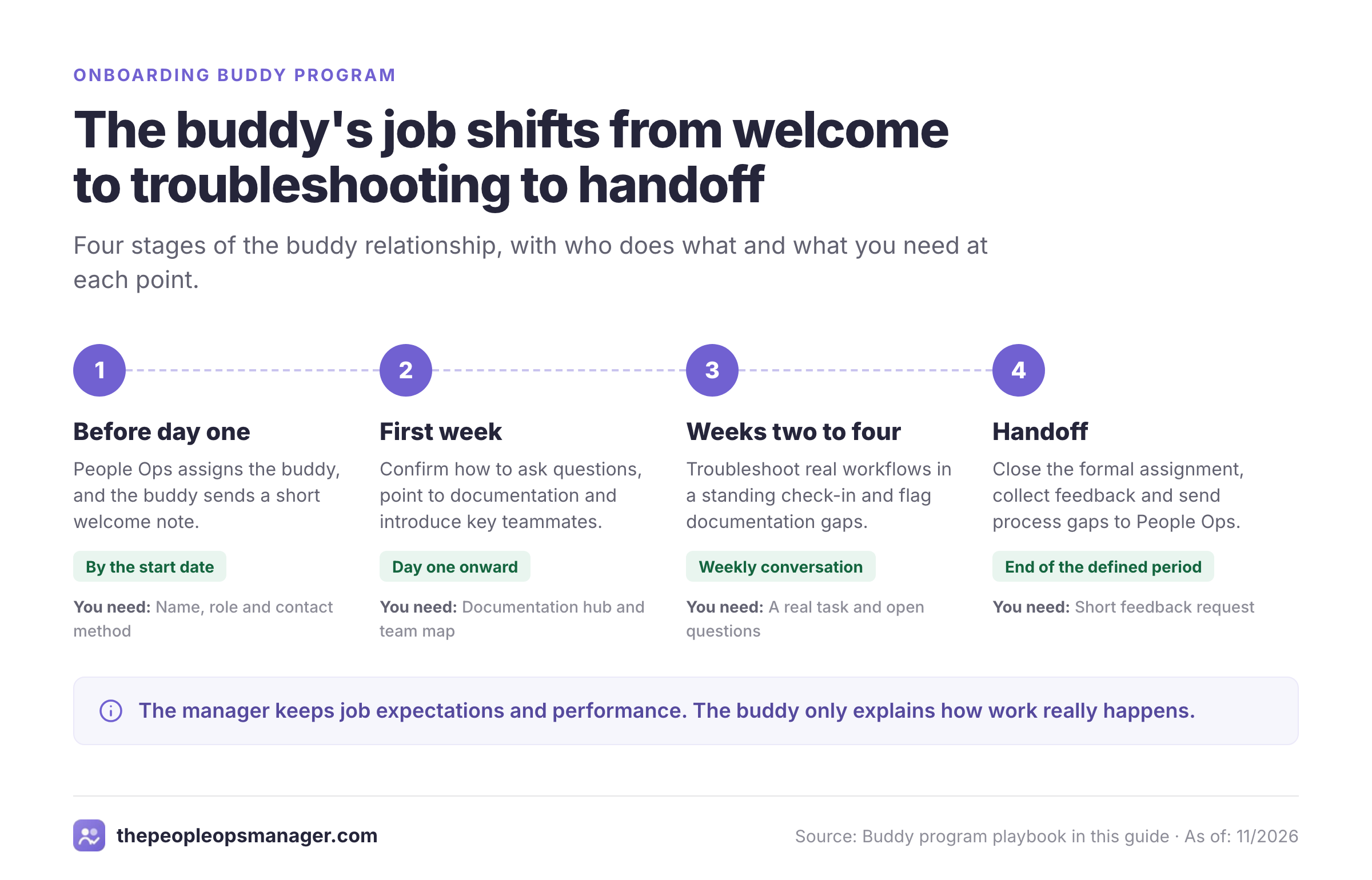
Before day one, People Ops should assign the buddy early enough for a warm introduction, but avoid sharing unnecessary personal details. Send the buddy the new hire's name, role, start date, working location or time zone, and approved contact method. Confirm that the manager owns role-specific onboarding and that IT owns access, using your employee onboarding checklist as the source of truth. The buddy can prepare a welcome note and a list of common questions. They shouldn't be responsible for ordering hardware or approving permissions unless that's already part of their job.
A short introductory message might say: 'Hi, I'm your onboarding buddy. I can help you find people, resources, and answers about how our team works. Your manager'll cover priorities and performance expectations. Would you like to meet for a short chat on your first day?' This sets expectations without turning the relationship into another formal review.
What should the first-week buddy checklist include?
On day one, the buddy should introduce themselves, confirm the easiest way to ask questions, and help the new hire understand the communication rhythm. They can point out where the team stores documentation, how to find meeting notes, and which channels are appropriate for urgent versus nonurgent questions. They should also introduce relevant teammates, ideally with context about what each person can help with.
Later in the first week, review practical scenarios. Ask the new hire how they'd request help with a blocked task, where they'd find a decision owner, and what they'd do if a meeting invitation conflicts with focused work. These aren't tests. They're opportunities to reveal gaps in documentation. If an answer's unclear, record the gap and send it to the owner of the underlying process.
A useful checklist covers contact preferences, team communication channels, documentation locations, introductions, routine request paths, meeting etiquette, and the escalation route for sensitive issues. It shouldn't duplicate the tasks in your new hire onboarding template such as payroll forms, compliance training, or security acknowledgments that have designated owners. The buddy's value is contextual explanation, not administration.
What should happen in weeks two through four?
In weeks two through four, the buddy should shift from orientation to troubleshooting. A weekly conversation can cover which processes still feel unclear, whether the new hire knows whom to ask, and which introductions would be useful. Encourage specific examples: 'Which request took longer than expected?' is more actionable than 'How is everything going?' The buddy can demonstrate how to navigate a common workflow, then let the employee perform it independently.
Keep meetings short enough to respect workload but regular enough that the employee doesn't feel they're interrupting. A standing calendar invitation can help. The pair can also communicate asynchronously. In distributed teams, document the best overlap window and avoid expecting immediate responses outside working hours. If the buddy's away, the program owner should identify a backup.
How long should the buddy relationship last?
A practical default is a defined introductory period followed by an explicit handoff, rather than an indefinite obligation. Some teams'll need only several weeks, while complex roles or remote arrangements may benefit from longer. Choose a duration based on the learning curve and adjust using feedback. Make clear that employees can remain friends or colleagues afterward, but the formal buddy assignment ends.
At the end, ask the new hire whether they know where to find help, understand the main collaboration paths, and have met the people they need. Ask the buddy which recurring questions exposed documentation gaps. The manager should review job readiness separately; that's a different conversation and performance. Don't use the buddy's private conversations as an unofficial performance report.
How do I run the program for remote and hybrid employees?
Remote hires need deliberate access to informal context because they can't rely on chance conversations. The buddy should explain communication norms, introduce colleagues across functions, and show where decisions are documented. Video calls are useful when both people prefer them, but chat and shared notes can be more accessible across time zones. Don't make camera use or after-hours social events a condition of participation.
Hybrid employees face a different problem: information that's shared in the office but not documented for remote colleagues. Ask buddies to flag decisions that need a written record. A buddy can't repair a poorly documented culture alone. People Ops should route repeated issues to the relevant process owner and ensure the new hire receives the same essential information regardless of location.
How should buddies handle difficult questions?
Give buddies a simple decision rule: answer routine navigation questions, locate the documented owner for policy questions, and escalate urgent or sensitive matters through established channels. If a new hire asks about an interpersonal conflict, the buddy can listen respectfully without promising absolute confidentiality or attempting an investigation. They should explain available reporting routes and encourage the person to contact the appropriate support function.
Buddies shouldn't retain private notes about health, family circumstances, protected characteristics, compensation, or complaints. If the program collects feedback, focus on process quality and avoid turning buddy logs into personal dossiers. Keep access limited, set a retention policy, and tell participants how their feedback will be used.
What should a buddy meeting agenda look like?
A first meeting can begin with introductions and preferred communication methods, then cover where to find team information, how to ask for help, and who owns common decisions. End by inviting the new hire to identify one process they would like to understand better. A later meeting can focus on a real workflow, outstanding questions, and useful introductions. The agenda should be a prompt, not a script that gets in the way of natural conversation.
Example questions include: 'What surprised you about how the team works?', 'Which acronym or process is still unclear?', 'Do you know where to find the latest project decision?', and 'Who would you like to meet next?' These questions encourage practical discussion without asking the buddy to judge the employee's competence.
How do I measure whether the buddy program works?
Start with leading indicators that are directly related to the program. Track the share of eligible new hires assigned a buddy before their start date, whether the first introduction occurred, and whether participants knew how to contact each other. Survey new hires about the usefulness of introductions, clarity of collaboration norms, and confidence in finding answers. Ask buddies whether the time commitment felt manageable, since it's the first thing to slip.
Compare feedback across cohorts, teams, and work arrangements where sample sizes permit. Don't infer causation from a small change in turnover or time to productivity. Other onboarding improvements may well happen at the same time. Qualitative comments can be particularly valuable when they're pointing at a missing document, confusing approval path, or recurring access problem. Report patterns rather than individual private conversations.
A simple monthly review can identify whether matches were delayed, meetings were skipped, or certain questions repeatedly surfaced. Assign an owner and a due date to each process improvement. If the program creates administrative work without clear value, simplify it. Success means that new employees can navigate the organization more confidently, not that every checklist box got ticked. That's the test.
What common mistakes should I avoid?
The most common mistake is treating the buddy as a replacement for the manager. A friendly colleague can't clarify job success criteria or approve priorities. Another mistake is assigning volunteers without capacity, leading to unanswered messages and an awkward experience. A third is leaving boundaries unclear, which can push buddies into policy, conflict, or performance matters they aren't equipped to handle.
Don't build overly rigid programs that require numerous meetings regardless of need. Avoid matching solely by tenure or job title when schedules don't overlap. Don't use buddy feedback as a covert employee evaluation. Finally, don't ignore recurring questions. If every new hire needs a buddy to locate the same resource, improve the resource and keep the buddy focused on human context.
Onboarding buddy program template
Use this template as the starting point for your pilot. It bundles the charter, the escalation map and the checklists for the buddy, the manager and the program owner in one place.
Onboarding buddy program template
Fill in the fields, copy the sections into your tracker, and adjust the wording to your policies. The example values show one realistic setup.
- Program owner
- People Ops
- Goal
- Help new hires navigate everyday collaboration and find the right people and resources
- Eligibility
- New employees in participating teams
- Buddy selection
- Volunteers with manager-approved capacity and relevant workflow knowledge
- Match criteria
- Schedule overlap, functional context and reasonable preferences
- Formal duration
- Defined at assignment, reviewed during the pilot
- First contact
- Introduction by the start date
- Cadence
- An initial conversation, then check-ins the pair agrees on
| Topic | Who owns it |
|---|---|
| Job expectations and performance | Hiring manager |
| System access and equipment | IT |
| Policy, pay and benefits | People Ops |
| Sensitive or urgent matters | Established reporting channels |
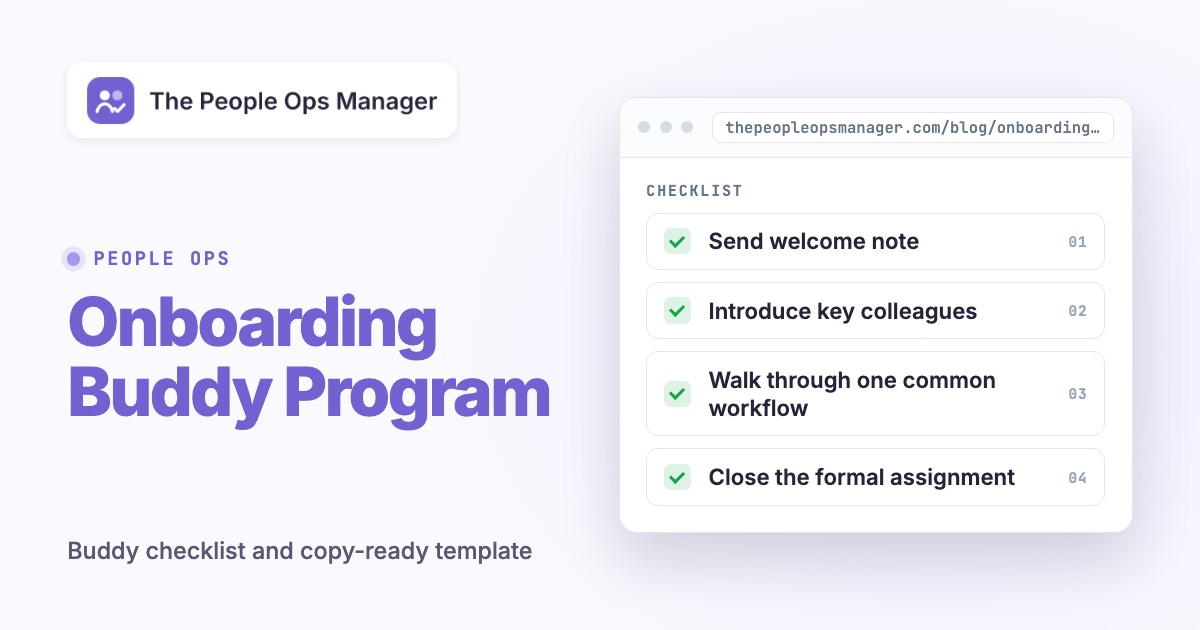
- Send welcome note
- Agree on contact method
- Explain communication channels
- Show the documentation hub
- Introduce key colleagues
- Walk through one common workflow
- Ask which processes remain unclear
- Direct sensitive questions to authorized owners
- Share anonymous process gaps with People Ops
- Close the formal assignment with a brief feedback request
- Explain the buddy role to the employee
- Protect the buddy's time
- Define job priorities yourself, separate from the buddy
- Make sure required systems and training are arranged
- Respond to process gaps escalated by People Ops
- Maintain the assignment tracker
- Monitor coverage
- Support rematching
- Review feedback
- Update the guide after each cohort
- I know whom to ask about everyday processes
- I can locate essential team documentation
- My buddy had enough time to help
- What one thing would make this easier? (open text)
Final checklist for People Ops
A good onboarding buddy program has a clear purpose, an available peer, a simple meeting rhythm, explicit boundaries, and a feedback loop. Begin with a manageable pilot that you can actually run. Make the first introduction easy. give buddies a practical guide, and ensure managers remain responsible for performance and priorities. Review what new hires still struggle to find and fix those underlying processes. Keep the program small enough that people use it.
Onboarding buddy program FAQ
Should an onboarding buddy be from the same team?
A same-team buddy isn't required. Same-team buddies can explain daily workflows quickly. Cross-team buddies can broaden networks. Choose based on the new hire's practical needs and available capacity.
Should buddies receive training?
Buddies should receive training. A short orientation should cover role boundaries, common resources, escalation routes, accessibility, and how to avoid giving unofficial policy advice. The goal is consistency without turning peers into HR specialists.
Can a buddy be the new hire's manager?
No. A buddy who is also the manager undermines the purpose of a separate low-pressure peer contact. Managers should provide their own structured onboarding and feedback. Assign a different colleague.
What if the pairing doesn't work?
A neutral rematching process helps. Offer a neutral rematching process. Scheduling conflicts and mismatched communication styles are normal operational issues, not failures that require blame.
Do we need onboarding software?
Onboarding software isn't required. A documented process, calendar invitations, and a small tracker can support a pilot. Consider additional tooling only when coordination or reporting complexity justifies it.